GEMSTONES
SHOP NOW


Cart
Your cart is empty
Your gifting options
Make your gift extra special with our luxury packaging options. Select a gift bag, gift box or a combination to create the perfect presentation.

Luxury Gift Box, Gift Bag & Wrapping Kit ($16.00)
Includes: CRAFTD Luxury Gift Box, Gift Bag, Tissue Wrapping Paper & Ribbon

Meaning Card ($4.00)
Add more meaning to your gift with a meaning card included with your order.
15 variations available

Gift Bag, Ribbon & Wrapping ($10.00)
Ideal for items that already include a gift box.
Includes: Premium CRAFTD Gift Bag, Ribbon & Tissue Wrapping. Doesn’t include: Luxury Gift Box.

Luxury Gift Box ($10.00)
Present your gift in our signature gift box, designed to impress before it’s even opened.
Includes: Premium gift box
Choose your option
To My Boyfriend

To My Son

To My Grandson

To My Brother

To My True Friend

To My Dad

A Symbol Of Protection

A Symbol of Luck

A Symbol Of Safe Travel

A Symbol Of Self Belief

A Symbol Of Adventure

A rope bracelet is a wrist chain of tightly wound links that spiral around each other, so the whole piece reads like a fine cord of metal rather than a row of flat links. On our version the links are diamond-cut, their faces shaved into tiny planes that flash and shift as your hand moves. That movement is the whole point of it: where a Cuban gives weight and a clean line, the rope trades in light and texture instead.
Below we'll get into what a rope bracelet actually is, how the twist is built, why it catches light the way it does, how to wear it, and how to land on the width and metal that work for you.
Jump to:
A rope bracelet takes the twist of a rope chain and sizes it for the wrist. Rather than flat links lying in a line, the links wind around each other in a continuous spiral, giving the bracelet a braided, cord-like surface with a little give to it. It's the one piece in the range built on texture instead of a flat face.
What sets it apart on the wrist is how it behaves in light. A flat bracelet gives you one clean reflection; the spiral gives you dozens of small ones, scattered around the twist and moving as your hand does. The diamond-cut faceting pushes that further, catching light at more angles again. That restless shine is why the rope reads warmer and busier than a plain chain bracelet, and why it comes into its own in gold. For the fuller story of the link itself, our rope chain guide covers the necklace in depth.
The rope has been a fixture in men's jewellery for decades, and it has lasted for a plain reason: the twist gives a bracelet life without any ornament to date it. There's no motif and no pattern to fall out of fashion, just texture and light. That's why it still looks current worn on its own, and why it tends to be a piece men keep rather than cycle out.
The texture is built into the piece, not stamped onto it, and that build is what separates a good rope from a cheap one. In short:
Two things mark out a rope that's been made properly. The twist should stay the same tightness the whole way along, with no loose or gappy stretches where the spiral drifts. And it should feel solid for its width, not hollow and tinny, because a solid build is what gives the twist its weight and keeps it from crushing out of shape. Both hold whether you're looking at a fine everyday rope or a wider one.
For their weight, they hold up well, and the twist is the reason. A flat chain leans on each single link to hold the line, so one weak link is a weak chain. A rope spreads that load across the whole spiral, with strands supporting one another, so there's no lone point for daily wear to work loose. On the wrist that matters, because a bracelet takes knocks a necklace never does, against desks, keyboards and door handles all day.
The finish decides how well it ages. A faceted surface has more edges for wear to catch than a smooth one, so a cheaply plated rope goes grey at the high points first. Ours sits on a solid 316L stainless steel core under real silver, 18k gold or rose gold, and carries a lifetime guarantee, so the twist keeps throwing light rather than dulling off. That's what lets a rope take showers, workouts and everyday wear in its stride.
We make the rope bracelet in two widths, each with a different job:
Both widths share the same diamond-cut and the same solid build, so the only real decision is how much of the twist you want on show. The two also wear happily together, a fine 2mm sitting alongside a 5mm for a little depth without piling on texture.
Gold flatters a rope more than any other finish, since the warmth of the metal feeds straight into the light-catching twist, while silver keeps the same texture cooler and quieter. Rose gold lands between the two. And if you like the woven look but want something softer against the skin, the leather rope bracelet swaps metal for braided leather with an engraved clasp. Compare them in the full rope collection.
A rope is a solo piece first. The twist is already carrying the look, so it rarely wants a neighbour, and over a plain tee in summer a gold rope lifts the whole outfit on its own, no pendant or second piece required. That self-sufficiency is a big part of the appeal: one bracelet, nothing to fuss over.
When you do stack it, put it next to something flat and calm rather than another texture. A rope beside a plain Cuban lets the smooth line and the spiral set each other off, where two textured pieces just blur into noise. Hold the stack to a couple of pieces and let the rope be the one with the movement. And run it on the opposite arm to your watch, so neither wrist ends up overloaded. For more on building a wrist, see our guide on how to wear bracelets for guys.
The rope earns its place in warmer, lighter looks especially. A gold rope against a white linen shirt or an open collar in summer picks up the sun and does more for the outfit than its width suggests. Worn with a plain tee it reads relaxed and a little lived-in; under a jacket sleeve it glints when you reach for something and then slips out of sight again. It's a piece that rewards movement, so it suits a wardrobe that isn't buttoned right up.
The rope bracelet and the rope chain are the same twist at two scales. Worn together in a single metal, that shared texture does the work of pulling an outfit together, which is why the rope set, necklace and bracelet in one, is the tidiest way to pick up both at once.
Where they part is how much twist each can carry. A necklace has room for a bolder spiral against the chest, so a heavier rope up top with a finer one at the wrist is a pairing that rhymes without simply repeating itself. If you're weighing up the necklace, the rope chain guide runs through widths and lengths in full.
In a family of flat links, the rope is the one twist, and that's exactly why people reach for it. Set against the others:
For every style laid out side by side, our guide to the types of men's bracelets is the place to look.
It tends to come down to width and finish.
If a rope is your first bracelet, a 5mm in gold is a forgiving place to start, with plenty of character for very little effort. Whatever you land on, size it before you buy: a rope wants to sit close but still travel a little on the wrist, and the bracelet sizing guide shows you how to measure in a minute.
As a gift, a rope is a safe bet precisely because it flatters most wrists and needs no styling to work, and gold is the more giftable of the two finishes. If it's joining a collection rather than starting one, it's the piece that adds movement to a wrist gone a little flat with plain links, the bit of texture the rest of the stack has been missing.
The twist is forgiving with scuffs, since a broken-up surface hides small marks a flat bracelet would show. The flip side is that all those little grooves give skin oils and dust more places to gather, so a rope likes a wipe more often than a plain piece does. A soft, dry cloth drawn along the spiral now and then keeps it bright; for a deeper clean, warm water and a soft brush worked gently into the twist lift out anything that's settled, then dry it fully before wearing.
The finish shrugs off water, sweat and heat, so a metal rope is happy in the shower and at the gym, though a rinse in fresh water after the sea keeps salt from dulling it. Keep it apart from your other pieces when it's off, since a loose twist will happily knot itself around a stray clasp. A leather rope is the exception all round and is best kept dry.
It's a bracelet made from links wound into a spiral, so it looks like a fine cord of metal rather than a row of flat links. On ours the links are diamond-cut, so they catch the light as your wrist moves.
Diamond-cut means the outer faces of the links have been lightly faceted, so they throw off more light than a plain, rounded rope. Same shape, more flash, and it's what gives the rope its shift and sparkle when you move.
Yes, for their weight. Because the twist shares the load across the whole spiral instead of a single link, there's no lone weak spot. On a solid steel core with a proper finish, a rope takes daily wear without pulling out of shape.
A 2mm is the slim, everyday width and the easiest to layer. A 5mm is the one most men settle on, where the twist reads clearly and the bracelet can stand on its own.
Wrap a tape or a strip of paper around your wrist, then leave a little slack so the rope sits close but still travels. That lands most men at 19cm or 22cm. The bracelet sizing guide has the full method.
Gold usually wins with a rope, because the warmth of the metal feeds the light-catching twist. Silver keeps the same texture cooler and more low-key. The tie-breaker is what you already wear, so it sits with the rest.
Best on the opposite arm to the watch, so one wrist isn't doing all the work and the two aren't rubbing together. A rope has enough going on to hold a bare wrist by itself anyway.
A metal rope, yes. The finish takes water, sweat and heat without trouble, and a quick freshwater rinse after the sea keeps it sharp. A leather rope is the one to keep dry.
Not while you're wearing it, since it's clasped shut on the wrist. Loose in a drawer is another matter, as the twist catches on stray clasps and links. Keep it apart from your other pieces and it stays clear.
Just the scale and the spot on the body. It's the same twisted link, worn at the wrist rather than the neck, and the two are made to go together. A common pairing is a bolder rope chain with a finer rope bracelet in the one metal.
If the rope is where you're starting, the 5mm is where most men land, with the slimmer 2mm for something quieter day to day. To see how it sits against the rest, read our guide to the types of men's bracelets, and for the same twist worn at the neck, the rope chain guide covers the necklace.
You'll find every rope in one place in the rope collection.
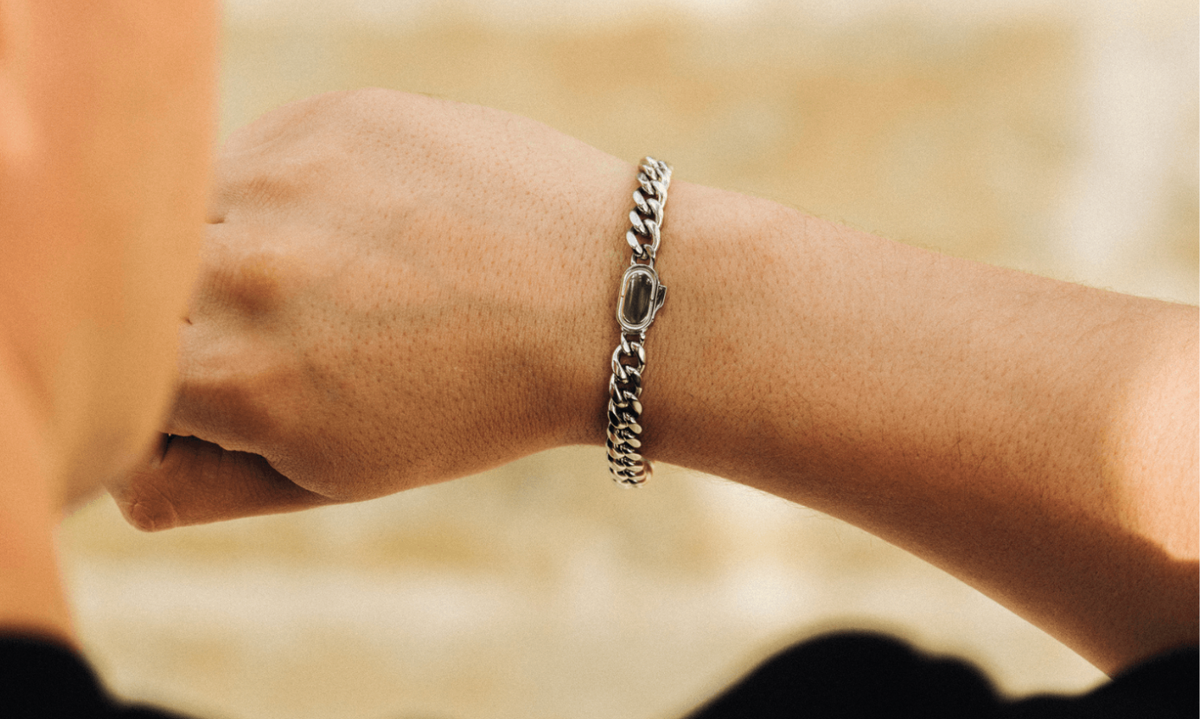
What Is a Cuban Link Bracelet?
The Cuban link bracelet is one of the most recognisable styles in men’s jewellery, defined by flat, interlocking links that sit smooth against the wrist. Here’s how it’s made, how to wear it and wh...
Read more
The cuff bracelet is defined by its open band, clean shape and easy adjustable fit. Here’s how it works, how to wear it, and how to choose the right width and metal for your wrist.
Read more

Leave a comment
This site is protected by hCaptcha and the hCaptcha Privacy Policy and Terms of Service apply.