GEMSTONES
SHOP NOW


Cart
Your cart is empty
Your gifting options
Make your gift extra special with our luxury packaging options. Select a gift bag, gift box or a combination to create the perfect presentation.

Luxury Gift Box, Gift Bag & Wrapping Kit (¥1,800)
Includes: CRAFTD Luxury Gift Box, Gift Bag, Tissue Wrapping Paper & Ribbon

Meaning Card (¥500)
Add more meaning to your gift with a meaning card included with your order.
15 variations available

Gift Bag, Ribbon & Wrapping (¥1,100)
Ideal for items that already include a gift box.
Includes: Premium CRAFTD Gift Bag, Ribbon & Tissue Wrapping. Doesn’t include: Luxury Gift Box.

Luxury Gift Box (¥1,100)
Present your gift in our signature gift box, designed to impress before it’s even opened.
Includes: Premium gift box
Choose your option
To My Boyfriend

To My Husband

To My Soulmate

To My Son

To My Grandson

To My Brother

To My True Friend

To My Dad

A Symbol Of Strength

A Symbol Of Faith

A Symbol Of Protection

A Symbol of Luck

A Symbol Of Safe Travel

A Symbol Of Adventure
If your earring holes are sore, smelly, or just feel a bit off, the earring is usually the problem before the ear is.
Most people go straight to cleaning the hole. Fewer think about the thing that's been sitting in it for six months, collecting skin oil and never once being washed. Sort that out and a surprising number of ear problems sort themselves out too.
Below we'll cover why earring holes get sore in the first place, how to clean both the hole and the earring properly, how to tell irritation from something that needs a professional, and why the metal you're wearing matters more than any cleaning routine.
Jump to:
Three causes, and only one of them is anything to worry about.
Build-up. A pierced hole is lined with skin, and skin produces oil and sheds cells like the rest of you. With an earring sitting in it, none of that gets washed away. It collects, it oxidises, and it develops a smell people are usually too embarrassed to search for. It's completely normal, it happens to everyone who wears earrings, and it takes about a minute to fix.
The metal. If a lobe is red, itchy or weeping only when a particular pair is in, that's a reaction to what the earring is made of rather than a hygiene problem. Nickel is the usual culprit, and we'll come back to it below because it's the single most common cause of earring trouble.
Actual infection. Much rarer than the internet suggests, and mostly limited to fresh piercings. Worth knowing the signs, which is the section after next.
For a healed piercing, this is genuinely simple and doesn't need a special product.
Once or twice a week is plenty for a healed piercing. Every day is unnecessary and can dry the skin out, which causes its own irritation.
If a hole has got properly gunky, don't force anything into it. Soften the build-up with warm water first, then clean as above. A cotton bud around the outside is fine; poking one into the channel is not.
This is the step almost everyone skips, and it's the one that actually solves the problem.
An earring that lives in your ear is in constant contact with skin oil. Clean the lobe and put a dirty earring straight back in, and you've achieved nothing.
For studs and hoops in steel or plated metal: warm water, a drop of washing-up liquid, a soft cloth or a soft-bristled toothbrush for the post and the back. Rinse, then dry completely before it goes back in. Wet metal in a warm ear is how you get irritation.
Pay attention to the butterfly back. It's the part with the most crevices, the least attention, and the most build-up. Half the time it's the back rather than the front that's causing the smell.
For anything with a stone or an iced face: treat the front as a plated finish, because that's what it is. Keep it out of a long soak, wipe it rather than scrubbing it, and stay away from abrasives and ultrasonic cleaners, both of which will take a plated surface off over time. Our guide to cleaning gold-plated jewellery covers that side properly. The post and back can be cleaned normally.
Do this every couple of weeks on earrings you wear constantly, and the sore-lobe problem mostly stops happening.
Worth being able to tell the difference, and worth being honest that only one of these is a job for a blog.
Irritation tends to be localised, appears with a specific pair of earrings, and settles down within a day or two of taking them out. Redness and itching without much else.
Infection is a different picture: increasing pain, heat, swelling that spreads beyond the piercing, yellow or green discharge, or a fever.
If it looks like the second one, that's a GP or a professional piercer, not a cleaning routine and not us. Same goes for a lump of thickened scar tissue forming around a piercing. There are real treatments for both, and guessing at home tends to make things take longer.
Here's the part most earring-care advice leaves out entirely.
Nickel is the most common contact allergy there is. It's why so many people believe they "can't wear earrings" when what they actually can't wear is cheap ones. A reaction to nickel looks exactly like a hygiene problem, which is why people scrub harder at something that scrubbing won't fix.
UK and EU rules limit how much nickel jewellery in prolonged skin contact is allowed to release, which is why a piece bought here from a reputable seller is far less likely to cause trouble than something unmarked bought cheap online.
And here's the bit that actually decides it: a contact reaction is caused by what touches your skin, not by what the whole piece is made of. On an earring, that's a very small part of the object. The post and the back sit in and against the piercing all day. The decorative front doesn't.
That distinction is why our earrings are built the way they are. The post and the earring back are solid stainless steel on every pair, chosen for exactly this reason, because those are the only parts going through you.
On our stone-set and iced pieces, the front is a solid alloy core rather than steel. That isn't a shortcut, it's a structural requirement: setting a stone properly means claws that can be worked and closed around it without cracking or springing open, and steel is too hard and unforgiving for that. The alloy holds a setting securely, then gets finished in rhodium or real 18K gold and polished. It sits on the outside of your ear, where it isn't in the piercing at all.
So the job gets split. Alloy where you need to hold a stone, steel where it passes through you.
Worth being straight on one thing though: stainless steel is described as hypoallergenic because it releases very little nickel, not because it contains none. Almost no steel does. The nickel is locked into the alloy so it stays put, which is why it suits the overwhelming majority of people. If you've had a diagnosed severe nickel allergy, implant-grade titanium is the material to ask a piercer about rather than any steel.
For everyone else the practical rule is simpler. If one pair irritates you and another doesn't, it's the pair, not your ears.
Everything above assumes a healed piercing. A new one is a small wound, and it's not our territory.
A lobe typically takes six to eight weeks and cartilage can take several months, though your piercer will give you a figure for the piercing you've actually got. Follow their aftercare rather than anything you read online, including this. If you're unsure or something isn't healing as expected, go back to them or speak to a GP.
One thing worth saying plainly: don't put fashion earrings into a fresh piercing. That includes ours. A healing piercing wants implant-grade titanium in it, fitted by the piercer, until they tell you it's ready to change. Our earrings are made for healed ears, and putting them in early is how a straightforward piercing turns into a difficult one.
Once you're fully healed and cleared to change, the usual progression is stud first, hoop after.
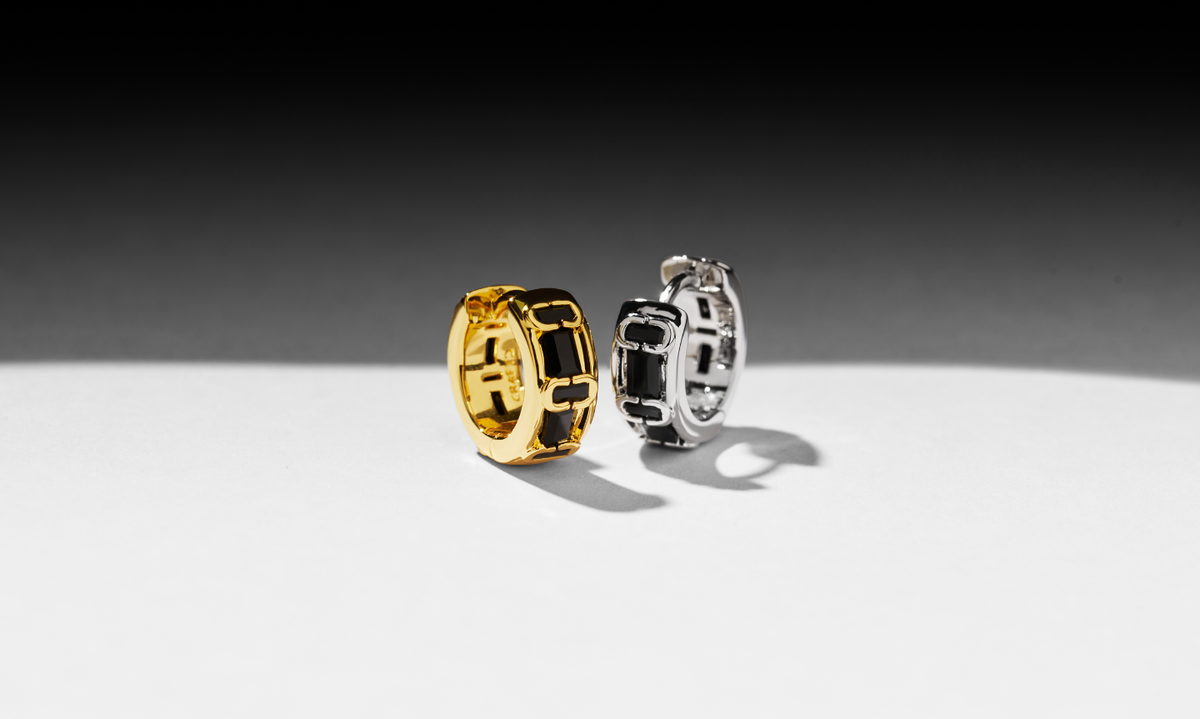
A stud sits flush and moves very little, which is why it's the sensible everyday starting point and the one to go back to if a lobe is feeling sensitive. Something like the Round Stud Earring is about as low-maintenance as an earring gets, and the Cross Stud or the Diamond Stud do the same job with a bit more to look at.
A hoop moves, catches on collars and jumpers, and rotates through the piercing as you wear it. That's fine on a well-healed lobe and a bad idea on a new or grumpy one. The Rounded Hoop is the easiest way in if you've only ever worn studs.
Whichever you go for, the cleaning routine is the same, and every pair in the earrings collection uses the same steel where it counts.
Skin oil, dead skin cells and bacteria collecting in the channel and on the earring post, with nothing washing them away. It's completely normal and it isn't a sign of infection. Clean the lobe and the earring itself and it goes.
Once or twice a week for a healed piercing. Daily isn't necessary and can dry the skin out. Clean the earrings on the same schedule, since a clean hole and a dirty earring gets you nowhere.
Almost always the metal rather than your ears. Nickel is the most common cause. If one pair is fine and another isn't, the problem is the pair.
They're generally advised against, because both are harsh enough to irritate the skin and slow healing. Mild soap and warm water does the job on a healed piercing. For a fresh one, follow what your piercer told you.
Spreading redness and swelling, heat, increasing pain, yellow or green discharge, or a fever. That's a GP or your piercer rather than something to treat at home. Mild redness and itching that settles when you take the earring out is more likely irritation.
For most people, yes. Stainless steel is used for skin contact because it releases very little nickel and handles being worn constantly. It isn't nickel-free though, so anyone with a diagnosed severe nickel allergy should ask a piercer about implant-grade titanium.
Not if the post is right. On ours, the post and back are solid stainless steel on every pair, including the stone-set ones, because that's the part sitting in your piercing. The decorative front is a solid alloy core, which is what holds a stone setting securely, and it stays on the outside of your ear.
Most earring trouble isn't an ear problem. It's a dirty earring, or the wrong metal, and both are easy to sort.
Clean the hole and the earring on the same day, wear something made properly, and the rest looks after itself. Have a look through the earrings collection if you're adding to yours.

How Much Is a Gold Ingot (Bar) Worth?
A gold ingot is worth its weight in troy ounces times the gold price times its purity. Here's how to do the sum, why gold uses its own ounce, and why you'll never get the spot price.
Read more
The Most Expensive Jewellery Ever Sold
What does the most expensive jewellery in the world actually cost, and what are those famous rapper chains really worth? One of those questions has a verifiable answer. The other doesn't.
Read more

Leave a comment
This site is protected by hCaptcha and the hCaptcha Privacy Policy and Terms of Service apply.