GEMSTONES
SHOP NOW


Cart
Your cart is empty
Your gifting options
Make your gift extra special with our luxury packaging options. Select a gift bag, gift box or a combination to create the perfect presentation.

Luxury Gift Box, Gift Bag & Wrapping Kit ($16.00)
Includes: CRAFTD Luxury Gift Box, Gift Bag, Tissue Wrapping Paper & Ribbon

Meaning Card ($4.00)
Add more meaning to your gift with a meaning card included with your order.
15 variations available

Gift Bag, Ribbon & Wrapping ($10.00)
Ideal for items that already include a gift box.
Includes: Premium CRAFTD Gift Bag, Ribbon & Tissue Wrapping. Doesn’t include: Luxury Gift Box.

Luxury Gift Box ($10.00)
Present your gift in our signature gift box, designed to impress before it’s even opened.
Includes: Premium gift box
Choose your option
To My Boyfriend

To My Husband

To My Soulmate

To My Son

To My Grandson

To My Brother

To My True Friend

To My Dad

A Symbol Of Strength

A Symbol Of Faith

A Symbol Of Protection

A Symbol of Luck

A Symbol Of Safe Travel

A Symbol Of Self Belief

A Symbol Of Adventure

Most articles about expensive jewellery quote two kinds of number as if they were the same thing. One kind is a matter of public record: a hammer price, on a date, in a room, with a receipt. The other is a figure someone mentioned in an interview, which got repeated, and then repeated again, until it hardened into a fact.
This piece keeps them apart. Here's what the most expensive jewellery in the world actually sold for, what the most famous chains in hip hop are reported to be worth, and why the gap between those two sentences matters more than any of the numbers.
Jump to:
These are auction results. Each one has a house, a city and a date attached, which means each one can be checked.
Auction records are quoted in US dollars, so that's how they appear below.
Sotheby's Hong Kong, April 2017.
A 59.60 carat internally flawless vivid pink diamond, cut from a rough stone mined in Africa. It sold in five minutes to Chow Tai Fook, who renamed it the CTF Pink Star. It remains the most expensive gemstone ever sold at auction.
Worth knowing: it had already been sold once, in 2013, for $83 million. The buyer defaulted. Sotheby's took it back onto its own books and sold it again four years later for less.
Christie's Geneva, May 2016.
A 14.62 carat vivid blue, named for the family that controlled De Beers for most of the twentieth century. It held the outright record for eleven months until the Pink Star took it.
Sotheby's Geneva, May 2017.
A pair of earrings sold as two separate lots: a 14.54 carat vivid blue pear shape and a 16 carat vivid pink one. The blue went for $42.1 million, the pink for $15.3 million. The same buyer took both and renamed them Memory of Autumn Leaves and Dreams of Autumn Leaves.
It's the record for a pair of earrings, and it's the one people most often get wrong, because the post-sale names are the ones that stuck.
Christie's Geneva, November 2018.
An 18.96 carat vivid pink, bought by Harry Winston and renamed on the spot. It didn't break the outright record, and articles that say it did have got it backwards. What it broke was the record price per carat for a pink diamond, at roughly $2.6 million for every carat.
That's the more interesting number anyway. It's the one that tells you what the market actually pays.
Sotheby's Geneva, November 2015.
A 12.03 carat vivid blue, bought by a Hong Kong property developer who named it after his seven year old daughter. The day before, he'd bought her a 16 carat pink and named that one Sweet Josephine.
Every stone on that list is pink or blue. That isn't a coincidence and it isn't fashion.
A white diamond is graded on how close it gets to nothing: no colour, no inclusions, no character. Millions of them qualify. The grading scale is a ladder that everyone is climbing.
Coloured diamonds work the other way round. The colour comes from something that went slightly wrong. Blue usually means boron in the carbon lattice. Pink is thought to come from the crystal structure being deformed under pressure, deep in the earth, in a way that bends how it handles light. Nobody set out to make either happen.
Vivid grade stones of any size are counted in handfuls per year, globally. So the price isn't really about beauty. It's about how few of them exist.
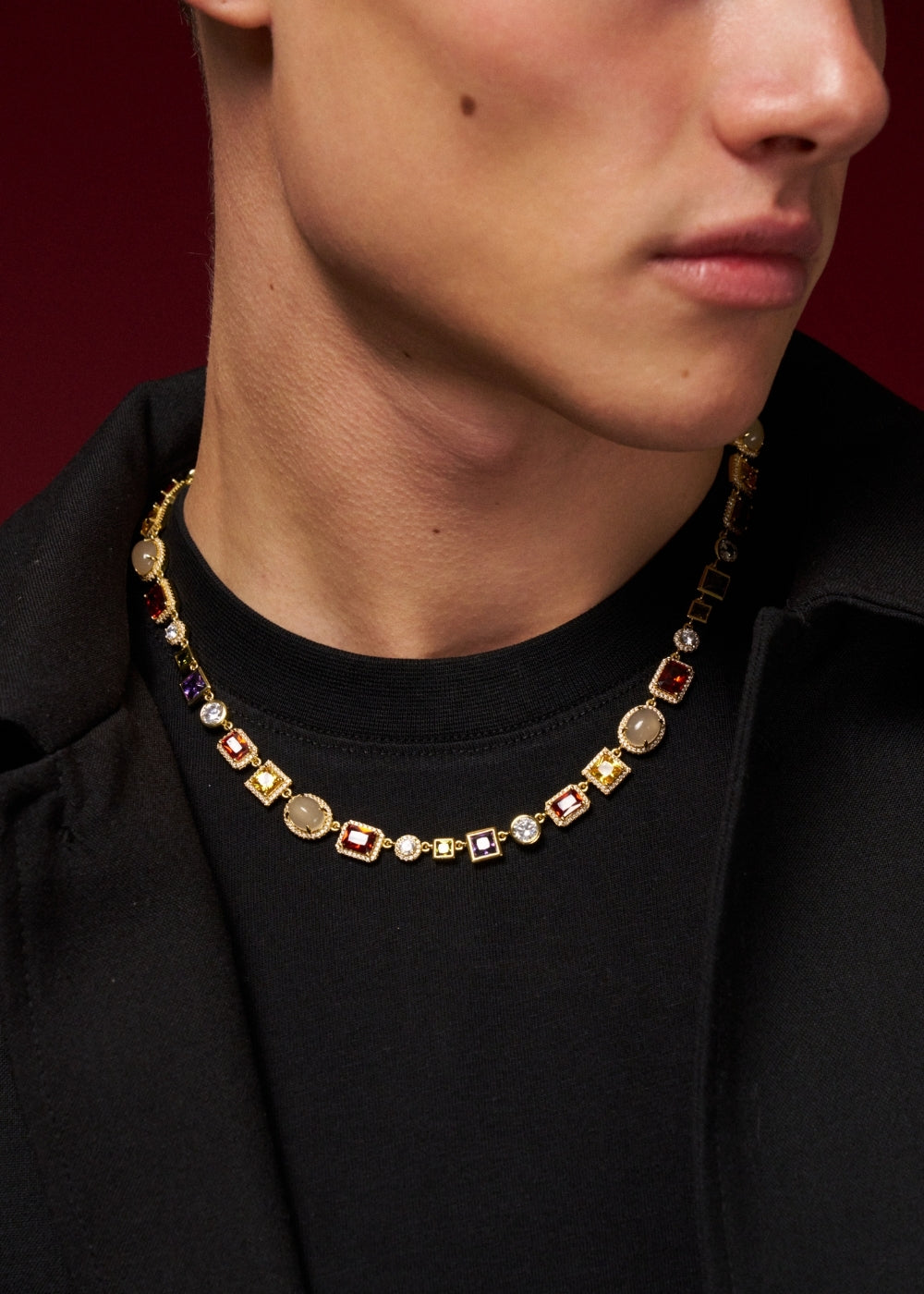
There's a second thing going on, and it's less about money. Colour carries a room in a way clear stones don't, at every level of the market rather than just the top of it. Our Gemstone Necklace is the fastest selling necklace we've ever made, and it's built on exactly that: ruby, amethyst, amber and emerald hues, each one handset in a bezel or four-claw frame, with larger round-cut opals breaking up the run. There's a sapphire version too, and an iced one if you want the stones working harder.
None of which is a $71 million diamond. But the reason your eye goes to it first is the same reason theirs did.
That logic runs all the way down the market, which is worth remembering the next time you're deciding between silver and gold, or reading up on what white gold actually is. Rarity sets the ceiling. Everything else is preference.
Now the other kind of number.
Read the next section before you take any of these to the bank. But here are the pieces that come up, and the figures that get quoted for them.
You'll notice something about that list. The owl is the most famous piece on it and the cheapest by a distance. Fame and price have almost nothing to do with each other here.
Here's the thing about every figure in that last section.
None of them came from a sale. They came from an interview, a jeweller's press release, or an estimate someone made by looking at a photograph. From there they went into a blog post, then into ten more blog posts, each one citing the last. Follow any of these numbers back far enough and you usually arrive at one person saying a number out loud, once.
Which is why the same chain turns up at wildly different figures depending on which article you land on, and every one of them states its number with total confidence. Nobody checks, because there's nothing to check against.
Auction results are different in a specific way. Two people who wanted the same object bid against each other in public, and the price is whatever the losing bidder stopped at. That number is real because somebody actually paid it.
A custom chain has no second bidder. It has a commission price, which reflects what one person agreed to pay one jeweller on one day, and that's assuming the reported figure is the commission price and not a guess.
Second-hand, most of them are worth considerably less than the number attached to them. Custom pieces are hard to resell, the stones are usually set for effect rather than grade, and the gold is worth its weight and carat whatever the design is.
So treat the list above as folklore. Good folklore, but folklore.
Strip out the celebrity and the story, and a chain's cost comes down to four things.
1. Weight. Gold is sold by mass. A 12mm Cuban link holds several times the metal of a 4mm one, and that difference is most of the price difference before anything else is considered. It's the least glamorous factor and the biggest.
2. Carat. 9ct is 37.5% gold, 18ct is 75%, 24ct is pure. Double the carat, roughly double the metal cost for the same weight. The number stamped on a clasp is a purity statement, and what the stamps mean is the single most useful thing to know when someone hands you a price.
3. Stones, and how they're set. This is where the real money goes on iced pieces. Not the stones themselves so much as the labour: every stone is set individually, by hand, and a fully iced chain can hold several hundred of them. Prong setting costs more than channel setting because more of each stone is left exposed, which takes longer and allows less margin for error.
You can see the effect of that labour without leaving our own range. A half iced Cuban and a fully iced one are the same links in the same finish. The difference in price is almost entirely the difference in setting work.
4. Whose name is on it. A commission from a jeweller with a reputation carries a premium that has nothing to do with materials. That's not a criticism. It's just worth knowing which part of the invoice is metal and which part is signature.
Everything else is finishing. Worth noting that plated and solid gold can look identical across a room and differ by a factor of twenty in price, and that 925 on a clasp tells you what you're holding better than any photograph will.
We're not going to pretend we're on that list.
What we will say is that most of what people respond to in an expensive chain is the setting and the light, not the certificate. Nobody across a room can tell a natural diamond from a well-set stone. What they can tell is whether the stones sit flat, whether the links catch light evenly, and whether the thing looks like it belongs on the person wearing it.
So that's where the work goes.
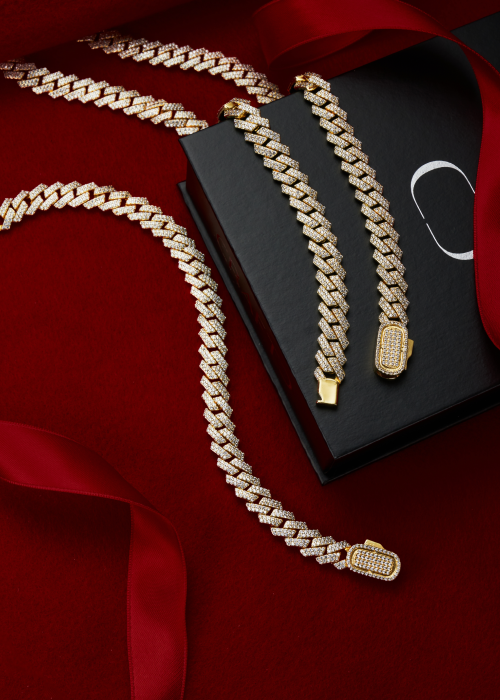
The Prong Link Iced Cuban above is handset with hundreds of AAA-grade stones in sharp, clean-cut links designed to sit flat on the neckline. The Tennis Chain uses a four-prong 18ct gold setting that protects each stone and maximises how much light it throws back. Both carry our snap-proof clasp and scratch-resistant protection.
If you want presence rather than shine, the 12mm Cuban is the heaviest link we make. And the Iced North Star is for anyone who'd rather their jewellery said something than shouted.
None of it costs $71.2 million. That was never the point.
The Pink Star diamond, at $71.2 million, at Sotheby's Hong Kong in April 2017. It's a 59.60 carat internally flawless vivid pink, and it remains the record for any gemstone sold at auction.
Pharrell's N.E.R.D chain, made by Jacob the Jeweler, is the one most often named, at a reported $1 million. That figure has never been tested by a sale, so treat it as a claim rather than a price.
It was reported at around $120,000 when it first appeared. Figures in the millions turn up in some articles and are errors that have been copied between sources.
Because far fewer exist. The colour comes from a flaw in how the stone formed, blue from boron and pink from structural deformation, and vivid examples of any size appear only a handful of times a year worldwide.
Generally no. Custom pieces are difficult to resell, stones in iced jewellery are usually set for appearance rather than certificated grade, and the gold is worth its weight and purity regardless of the design. Buy a chain because you want to wear it.
Look for the stamp. 925 means sterling silver, 375 means 9 carat gold, 750 means 18 carat. The stamp is a purity statement and it is the fastest way to know what you are holding.
The pieces at the top of this article will spend the rest of their lives in vaults, which is a strange fate for something made to be worn.
Yours shouldn't. Have a look at the ICED collection if you want the shine, or the full chain range if you'd rather start with the weight.
How to Clean Earring Holes (And the Earrings That Go In Them)
Sore or smelly earring holes are usually the earring's fault, not your ear's. Here's how to clean both properly, how to spot a metal reaction, and when it's a job for a professional.
Read more
What Does a Pinky Ring Mean on a Man?
Wondering what it means when a man wears a ring on his little finger? From British signet tradition to American class rings, here's where that meaning actually comes from, and how to wear one yours...
Read more

Leave a comment
This site is protected by hCaptcha and the hCaptcha Privacy Policy and Terms of Service apply.