GEMSTONES
SHOP NOW


Cart
Your cart is empty
Your gifting options
Make your gift extra special with our luxury packaging options. Select a gift bag, gift box or a combination to create the perfect presentation.

Luxury Gift Box, Gift Bag & Wrapping Kit (¥1,800)
Includes: CRAFTD Luxury Gift Box, Gift Bag, Tissue Wrapping Paper & Ribbon

Meaning Card (¥500)
Add more meaning to your gift with a meaning card included with your order.
15 variations available

Gift Bag, Ribbon & Wrapping (¥1,100)
Ideal for items that already include a gift box.
Includes: Premium CRAFTD Gift Bag, Ribbon & Tissue Wrapping. Doesn’t include: Luxury Gift Box.

Luxury Gift Box (¥1,100)
Present your gift in our signature gift box, designed to impress before it’s even opened.
Includes: Premium gift box
Choose your option
To My Boyfriend

To My Husband

To My Soulmate

To My Son

To My Grandson

To My Brother

To My True Friend

To My Dad

A Symbol Of Strength

A Symbol Of Faith

A Symbol Of Protection

A Symbol of Luck

A Symbol Of Safe Travel

A Symbol Of Adventure
Ruby is red with a reputation. Kings set it in their crowns, warriors carried it into battle, and for well over two millennia it has been the stone of power and nerve. A single ruby pendant, necklace or bracelet is still one of the boldest things a man can wear, and one of the easiest to get right.
Here we cover what ruby really is, the red stones it gets mixed up with, what it has meant, and how to wear red without overdoing it.

One red stone, nothing else. Featured: Ruby Stone Pendant (Gold).
Jump to:
Ruby is the red form of a mineral called corundum. Corundum is colourless when it's pure; a trace of chromium in the crystal turns it red, and the more chromium, the deeper the colour. Every other colour of corundum is sold as sapphire, so ruby and sapphire are, in effect, the same stone in different shades.
It's also one of the hardest natural materials there is. At 9 on the Mohs scale, only diamond beats it. That's why fine rubies keep their sharp edges and polish for generations.
The name comes from ruber, Latin for red. For centuries the most prized stones came from the Mogok valley in Myanmar, and the finest shade of all, a pure red with a hint of blue, is still known in the trade as pigeon's blood. Today Mozambique, Thailand and Sri Lanka are major sources too.

Four claws, one deep red stone. Featured: Ruby Stone Pendant (Gold).
Ruby's meanings come straight from its colour: blood, fire and life. Take them as history and belief rather than anything a stone can guarantee.
In ancient India ruby was called ratnaraj, roughly the ruler of precious stones, and it has sat in royal regalia from Asia to Europe ever since. It's the stone of people in charge, and of people who intend to be.
Legend has it that warriors in Burma wore rubies against their skin, believing the stones would keep them from harm in battle. Red stood for bravery long before anyone wore a uniform.
As the colour of the heart, ruby has always been tied to love and commitment. It's no accident that the fortieth wedding anniversary takes its name.
Medieval Europeans believed a ruby would darken to warn its owner of danger. Our own ruby pieces carry the same old idea: a source of power and protection.
Before modern gem testing, almost any red stone could be called a ruby, and some of the most famous "rubies" in history turned out to be something else.
So if someone tells you their family heirloom is a ruby, it might be. It might also be a perfectly good spinel or garnet with a longer story than they realise.
Red is the colour men are most wary of wearing, which is exactly why a small amount of it lands so well.

Red reads strongest against black. Featured: Ruby Stone Pendant (Gold).
A fine natural ruby can cost more than a diamond of the same size, and most stones on the market have been heated, and sometimes filled with glass, to improve their colour and clarity. That makes natural ruby a big commitment for an everyday piece.
Ours are ruby-coloured stones, chosen and cut to give that same wine-dark red, then set into gold or silver frames and finished with a scratch-resistant coating. All of the colour and symbolism is there; the price tag and the worry aren't, so you can wear it daily and never think twice.
If you're buying natural ruby elsewhere, ask for an independent laboratory report. It will say whether the stone is natural or lab-grown and whether it's been heated or glass-filled, which makes a big difference to its value.
Ruby is the most attention-grabbing stone in the range, so give it the job on its own. A ruby pendant and a ruby bracelet at once is usually one too many. Keep everything else plain metal or black.
Gold and red have been paired in royal jewellery for centuries, and the combination still looks warm and rich. Silver makes the red look brighter and a little more modern, and it's the natural choice if your watch and rings are steel or silver.

The same red, cooler in silver. Featured: Ruby Stone Pendant (Silver).
Black, navy, charcoal and deep green make red glow. A black T-shirt, a dark knit or a leather jacket is all the background ruby needs. Avoid other strong reds in your clothes and leave the stone to carry the colour alone.
A ruby pendant looks best where it can be seen through an open collar, on the flat of the chest just below the collarbone. Higher and it crowds the neck; lower and it disappears under a button.
Curious how ruby stacks up against onyx, emerald and the rest? Our stone-by-stone meanings guide lines them all up.
Each of these uses ruby-coloured stones and comes in gold or silver, ranked by sales over the past twelve months.
Our best-selling ruby piece, and the simplest way to wear the colour. The Ruby Stone Pendant holds one rectangular, deep red stone in four sturdy claws, with etched detail around the setting and a Cuban chain to hang from. It's also made in silver. See more single stones in our stone pendants.

Small, but you notice it. Featured: Ruby Stone Pendant (Silver).
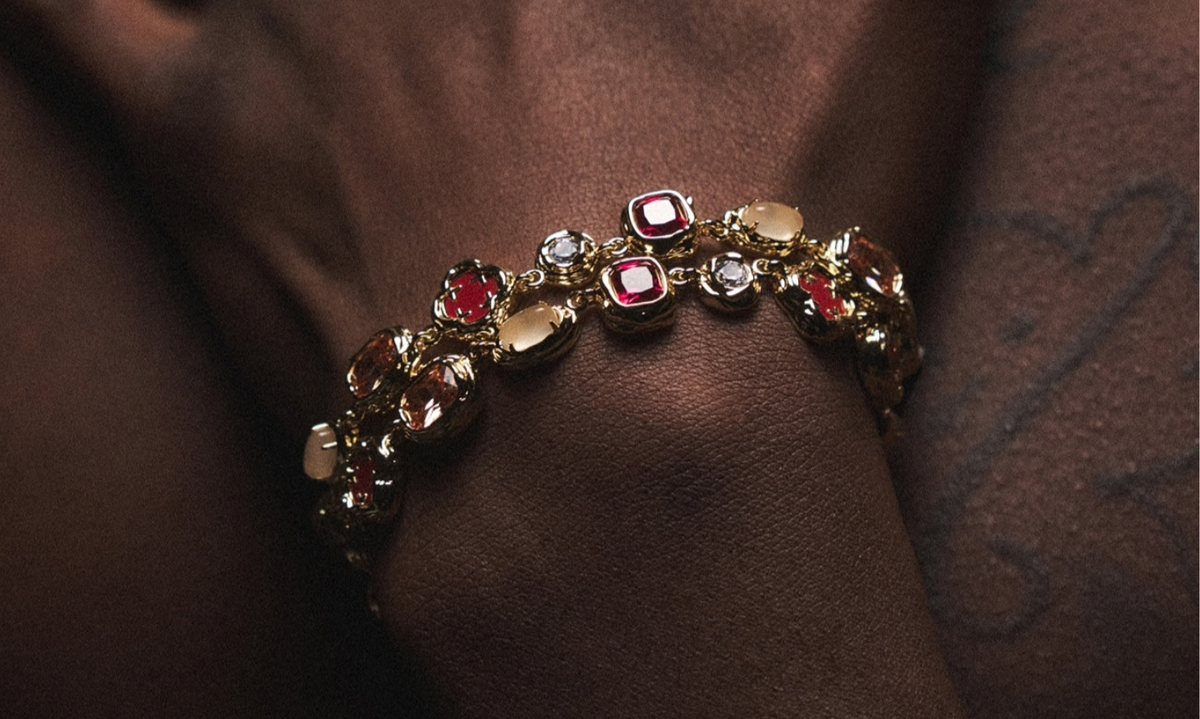
The Melted Ruby Gemstone Bracelet mixes deep ruby and softer rose stones, each in a molten-looking 18K gold bezel, with pale opals, small red clovers and crystals in between. The back is left open so light reaches every stone, and the clasp is snap-proof. There's a silver version too. Browse more in our gemstone bracelets.

Red at the cuff. Featured: Melted Ruby Gemstone Bracelet (Gold).

Molten gold around every stone. Featured: Melted Ruby Gemstone Bracelet (Gold).

Silver keeps the red sharp. Featured: Melted Ruby Gemstone Bracelet (Silver).
The same melted design around the neck. The Melted Ruby Gemstone Necklace carries the same ruby and rose stones in melted settings along coupled links, shown at 50cm, where it sits just below the collarbone. It's the statement piece of the ruby range, and it's also made in silver.

Ruby and rose, set in gold. Featured: Melted Ruby Gemstone Necklace (Gold).

Leather, black and one flash of red. Featured: Melted Ruby Gemstone Necklace (Gold).

A cooler frame for a warm stone. Featured: Melted Ruby Gemstone Necklace (Silver).

Dark clothes, bright stone. Featured: Melted Ruby Gemstone Necklace (Silver).
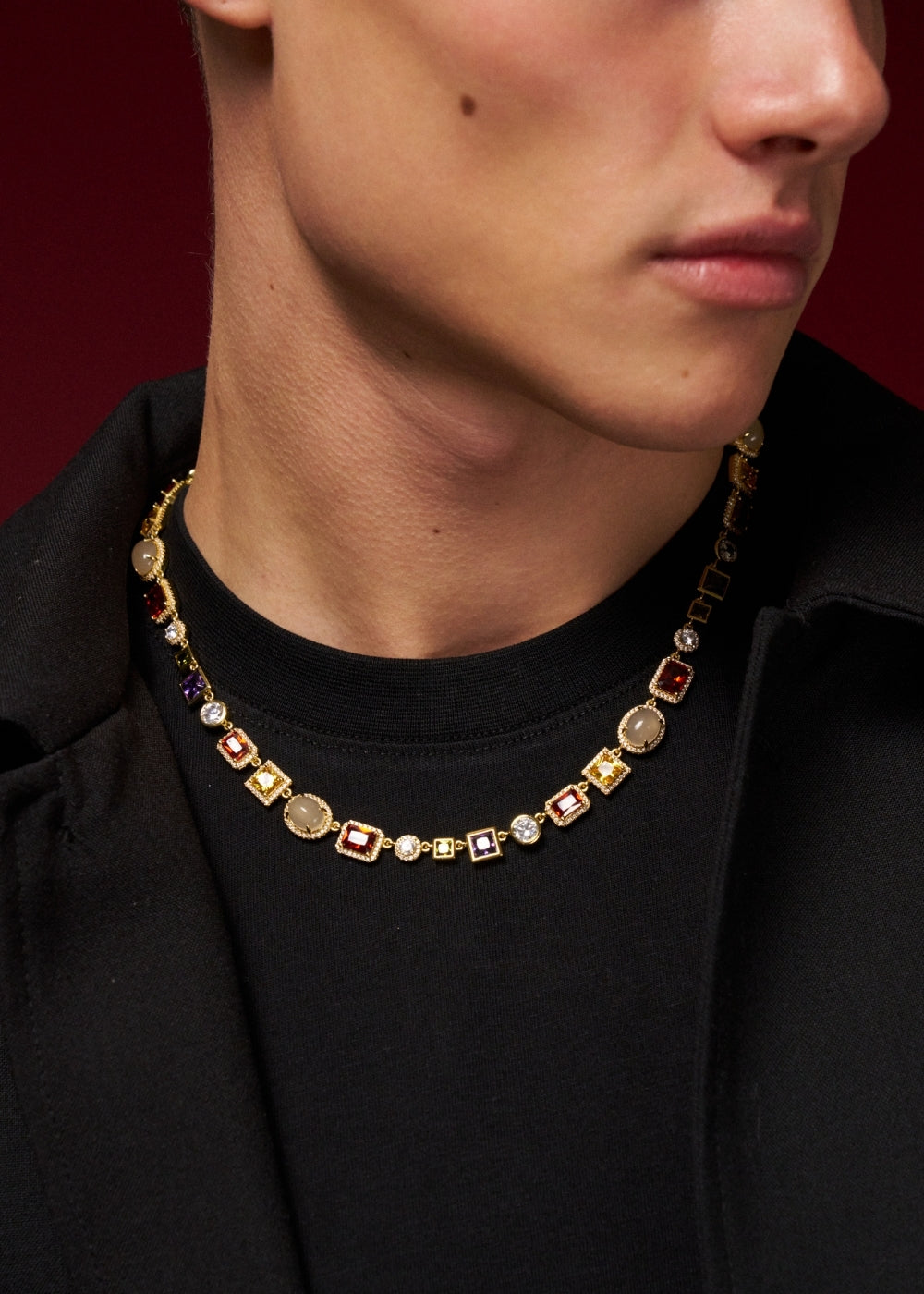
If you'd rather wear red alongside other colours, our Gemstone Necklace, the fastest seller of all our necklaces, puts ruby tones next to amber, amethyst, emerald and opal. For every option, browse our gemstone jewellery.
Not every red stone in our range is a ruby. Our Red Clover pieces and the Red Gemstone Clover Necklace carry a lighter, warmer coral red, and coral comes with its own story of protection and abundance, sailors and the sea.
The quick way to tell them apart: ruby is deep, cool and wine-dark; coral is brighter and closer to orange. If you want power and intensity, choose ruby. If you'd like something a little lighter and more relaxed, coral is the one.
Few stones come with as many ready-made reasons to give them.
Ruby has traditionally stood for power, courage and passion, and it was long worn to keep danger away. That's folklore and history, not science. For a man today, a ruby often marks ambition, a relationship, or a year that mattered.
No. They're ruby-coloured stones rather than natural ruby, mounted in gold or silver with a scratch-resistant finish. That keeps the deep red affordable, and it means a knock or a scratch isn't a disaster.
A natural ruby is very hard, so its facet edges stay crisp, and under magnification it usually shows tiny needles or specks inside. Gas bubbles point to glass. Many rubies are also heated or filled with glass to improve them, which a gem laboratory report will tell you. If a large, flawless red stone seems cheap, it almost certainly isn't natural.
All three can be deep red, and for centuries they were confused. Ruby is a red form of corundum and is harder than either. Garnet tends towards a darker, browner red, and spinel is a separate mineral that was often mistaken for ruby, including in some royal crowns.
They're the same mineral, corundum. Red corundum is called ruby and every other colour is sold as sapphire. Chromium is what turns it red.
Yes, it's July's birthstone. Forty years of marriage are also marked with ruby, which is why that milestone is called a ruby anniversary.
Yes. Red has been worn by men as a sign of rank and courage for centuries, from royal regalia to military dress. The key is quantity: a single red pendant or bracelet looks confident, not loud.
Better not. Soap, chlorine and salt water wear down finishes and dull settings over time, whatever the stone. Keep your ruby pieces for dry wear, put fragrance on before them, and store each one separately so the stones don't knock against other jewellery.
Ruby has been the stone of rulers and fighters for a reason. Choose one piece, wear it against something dark, and let the red do the talking.
Start with our stone pendants, or browse the whole gemstone range.
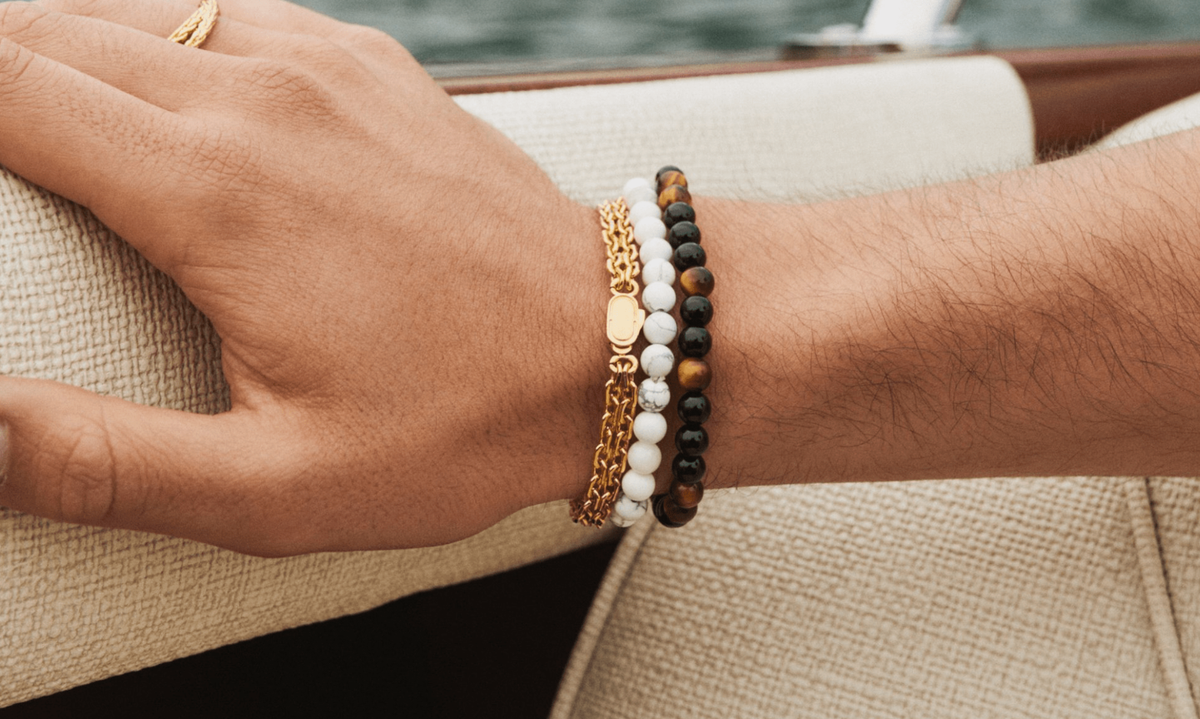
A Man’s Guide to Tiger’s Eye: The Stone of Confidence
Want a stone that backs you up rather than shows off? Here’s what tiger’s eye is, why men carry it for nerve and focus, and how to wear a tiger’s eye bracelet or necklace.
Read more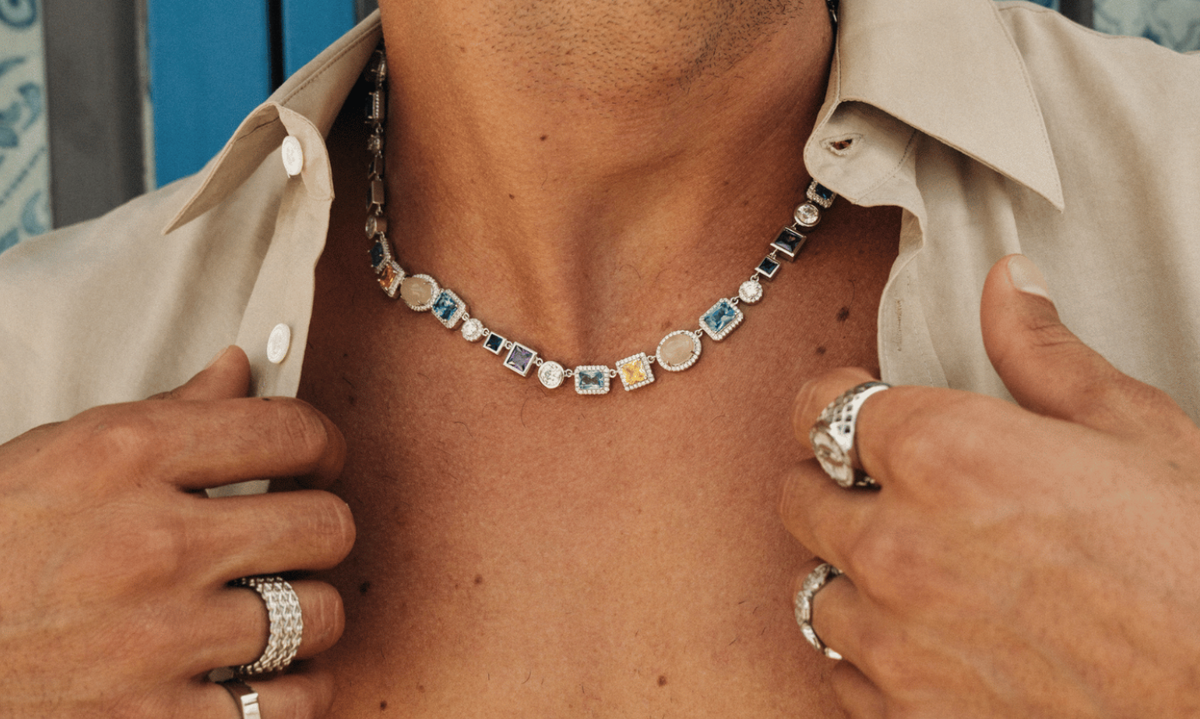
Sapphire for Men: Why Blue Is the Easiest Stone to Wear
Not sure a coloured stone suits you? Blue almost certainly does. Here’s what sapphire has stood for, where the finest blues come from, and how to wear a sapphire pendant or necklace without a secon...
Read more

Leave a comment
This site is protected by hCaptcha and the hCaptcha Privacy Policy and Terms of Service apply.