GEMSTONES
SHOP NOW

Cart
Your cart is empty
Your gifting options
Make your gift extra special with our luxury packaging options. Select a gift bag, gift box or a combination to create the perfect presentation.

Luxury Gift Box, Gift Bag & Wrapping Kit (¥1,800)
Includes: CRAFTD Luxury Gift Box, Gift Bag, Tissue Wrapping Paper & Ribbon

Meaning Card (¥500)
Add more meaning to your gift with a meaning card included with your order.
15 variations available

Gift Bag, Ribbon & Wrapping (¥1,100)
Ideal for items that already include a gift box.
Includes: Premium CRAFTD Gift Bag, Ribbon & Tissue Wrapping. Doesn’t include: Luxury Gift Box.

Luxury Gift Box (¥1,100)
Present your gift in our signature gift box, designed to impress before it’s even opened.
Includes: Premium gift box
Choose your option
To My Boyfriend

To My Husband

To My Soulmate

To My Son

To My Grandson

To My Brother

To My True Friend

To My Dad

A Symbol Of Strength

A Symbol Of Faith

A Symbol Of Protection

A Symbol of Luck

A Symbol Of Safe Travel

A Symbol Of Adventure
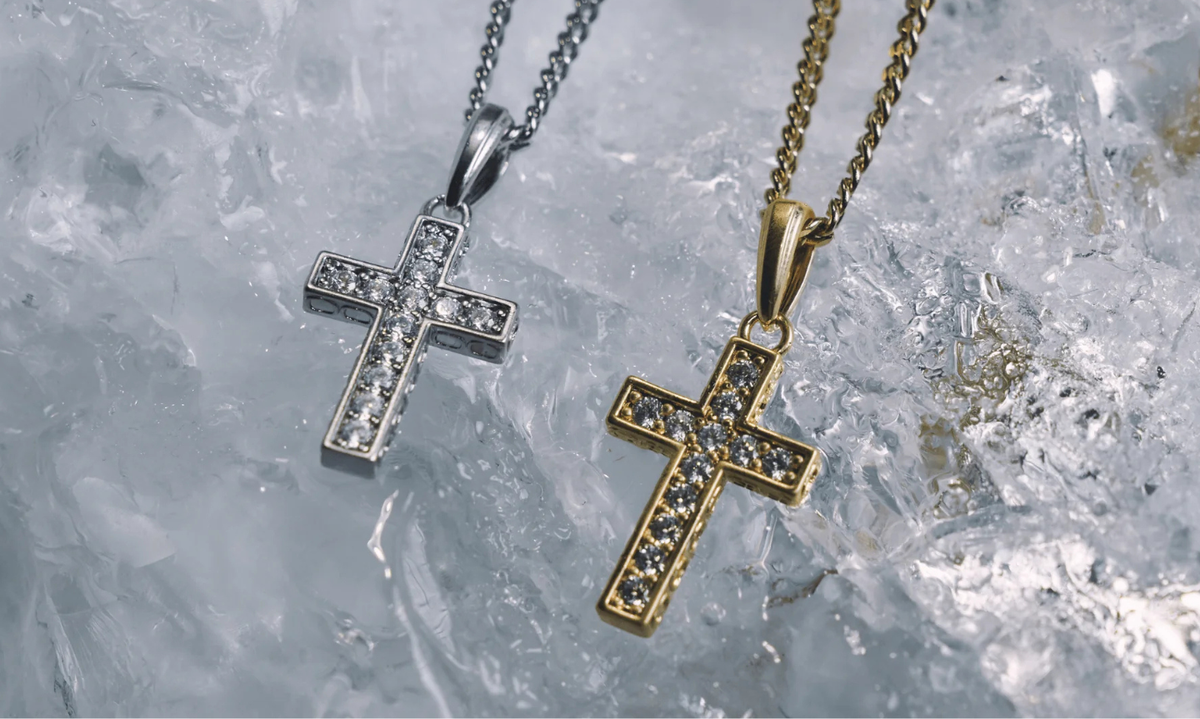
Every clear stone we set is cubic zirconia. Not diamond, not "diamond-like", not a VVS anything. It's a crystal made in a lab that does one job very well, which is throwing light around, and we'd rather say that up front than leave a product listing to blur it.
Here we cover what cubic zirconia is, where it came from and how it measures up against a diamond, plus what the AAA and VVS labels on iced jewellery actually mean. Then we get into our own iced pieces, how to wear them and how to keep them bright.

Hundreds of stones, all of them cubic zirconia. Featured: Prong Link Iced Cuban (Silver) 8mm.
Jump to:
Cubic zirconia, usually shortened to CZ, is zirconium dioxide grown as a crystal. In its everyday form that compound is a plain white powder, used in ceramics and dental crowns. Melt it at around 2,700°C, add a little yttrium or calcium oxide to hold its shape, and it cools into a clear, colourless crystal with a cubic structure. The name simply describes that structure.
Two points are worth getting straight early. CZ is not a diamond and has no carbon in it at all. It also isn't zircon, a natural gemstone that has been mined for thousands of years and only shares part of the name.

Lab-grown, hand-set, matched stone to stone. Featured: Tennis Bracelet (Silver) 5mm.
Cubic zirconia does occur in nature, but only as grains far too small to see. Two German mineralogists first identified them in 1937, locked inside other minerals. Every CZ you'll find in a piece of jewellery has been made by people.
The breakthrough came from Soviet scientists in the early 1970s. At the Lebedev Physical Institute in Moscow, they refined a technique known as skull melting. Zirconium dioxide is heated with radio waves inside a cage of water-cooled copper tubes, so the outer crust stays solid and works as its own container while the middle turns liquid. As the melt slowly cools, crystals grow. In Russia the stones were called fianit, after the institute's initials.
By the end of that decade CZ was being produced in volume and sold worldwide. It quickly overtook the older lab-made stand-ins, such as strontium titanate and YAG, because it looked closer to the real thing and cost less to make.
At arm's length, in ordinary light, most people can't tell a well-cut CZ from a diamond. Up close, and with a couple of simple checks, the differences show. None of them make CZ worse to wear. They just make it a different material.
| Property | Cubic zirconia | Diamond |
|---|---|---|
| Made of | Zirconium dioxide | Carbon |
| Where it comes from | Grown in a lab | Mined, or grown in a lab |
| Hardness (Mohs) | 8 to 8.5 | 10 |
| Fire (rainbow flashes) | Stronger | Softer |
| Brilliance (white sparkle) | Slightly less | More |
| Weight for the same size | Roughly 1.7 times heavier | Lighter |
| Heat | Holds on to it | Draws it away fast |
| Clarity | Almost always flawless | Nearly always has tiny inclusions |
At 8 to 8.5 on the Mohs scale, CZ is harder than quartz, which is what most household dust and grit is made of, so everyday knocks rarely mark it. A diamond will scratch it, though, and after years of heavy wear the sharp edges of each facet can start to soften.
CZ splits light into its colours more strongly than diamond, so under bright lights it throws more little rainbow flashes. A diamond bends light more sharply and sends back more pure white sparkle. Side by side, that's usually the first thing a trained eye notices.
CZ is much denser than diamond. A cubic zirconia cut to the size of a one-carat diamond weighs around 1.7 carats. You won't feel it in a single small stone, but across hundreds of them it adds a reassuring weight.
Grown in controlled conditions, CZ is nearly always free of the tiny crystals and feathers found inside mined stones. Its flawlessness is one of its tells. Another is the breath test: breathe on a diamond and the mist clears in a second or two; on CZ it lingers. A jeweller's tester, which measures how fast heat moves through the stone, settles it straight away.
Moissanite and lab-grown diamond sit between the two. Lab-grown diamond is diamond in every chemical and physical sense, only made above ground. Moissanite is silicon carbide, harder than CZ at around 9.25 and even more fiery. Our guide to diamond chains compares all three on price.
AAA is a quality grade, though not an official one. No independent lab certifies cubic zirconia the way diamonds are graded. Makers sort their own stones instead, usually on a ladder that climbs from a single A to five, judging how precisely each one is cut, how clear and colourless it is, and how well it has been polished.
Lower grades tend to have rounded facet edges, a hint of haze or a faint tint, and they lose their life quickly once grime builds up. At AAA, stones are cut cleanly and matched closely enough that a long row looks even. That counts most on iced pieces, where hundreds of stones sit shoulder to shoulder and one dull one gives the game away.
Across our iced range, the clear stones are hand-selected AAA-grade cubic zirconia. So when you see "AAA" on one of our product pages, it means a cut and clarity grade for CZ, not a diamond grade. The coloured gems that sit beside it on some pieces are a different story, told in our gemstone meanings guide.
VVS stands for "very, very slightly included". It comes from the clarity scale used for diamonds, which starts at flawless, steps down through VVS and VS, and ends with stones whose inclusions you can spot without a loupe. In a VVS diamond the flaws are so small that a trained grader struggles to find them at ten times magnification.
Iced jewellery borrows the term freely. On a listing, "VVS" is often shorthand for moissanite, and sometimes it simply means "very sparkly". On cubic zirconia it tells you very little, because CZ comes out of the lab clear and is almost never included in the first place. A clarity grade only means something on a stone that could have been flawed.
That's why VVS doesn't appear on our product pages. If a piece is sold as VVS, it's worth asking two questions: what is the stone, and who graded it?
We could chase the word diamond. We'd rather spend the money on what shows. With CZ, the budget goes into the things that decide how an iced piece looks after a year of wear: the setting, the finish, and the hours it takes to place each stone by hand.
It changes how you wear it, too. A diamond chain is something people insure and worry about. A CZ chain is something you put on for a Friday night and wear to a wedding the next afternoon without thinking twice.
Most of the price of any iced piece is labour rather than stone, a point our look at the world's most expensive chains makes from the other end of the market.
The stone is only half the story. These are the details we'd check on any iced piece, ours included.
Stones should be the same size, sitting level and evenly spaced. Tilt the piece under a lamp: good work flashes all the way along, while poor work flickers in patches where stones lean at odd angles.

Even rows, level stones, no gaps. Featured: Prong Link Iced Cuban (Silver) 8mm.
Each claw should be small, even and folded snugly over its stone. Run a finger along the piece; nothing should snag on a jumper or a shirt cuff.
Good CZ is colourless or, on our blue pieces, an even blue from end to end. A yellow or grey cast, or a few stones looking milky beside their neighbours, points to a lower grade.
Ranked by the past year's sales, best first. Every one is finished with AAA-grade cubic zirconia.
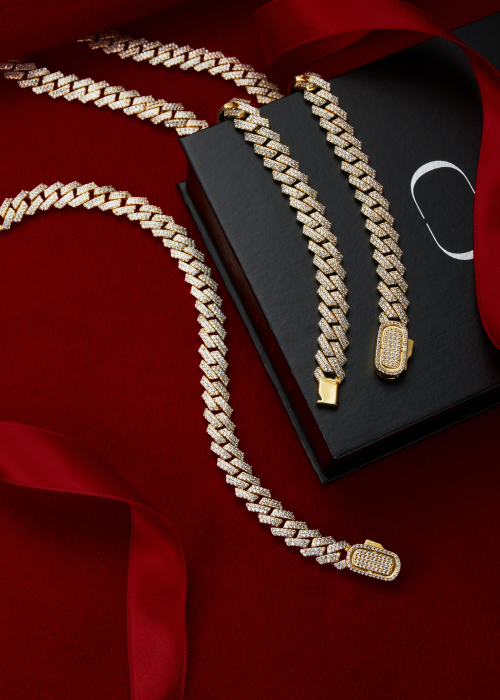
Our best-selling iced piece. The Prong Link Iced Cuban carries several hundred stones, each AAA-grade CZ set by hand, across sharp, clean-cut links that lie flat on the chest instead of rolling. Silver sells more, but the gold version carries the same stones in a warmer frame.

The same stones in a warmer frame. Featured: Prong Link Iced Cuban (Gold) 8mm.
Here the stones frame rather than cover. A border of AAA-grade CZ runs around a detailed St Michael medallion, so the saint stays the focus and the stones add the light. It comes in gold, our second-best seller in the iced range, and silver.

A frame of stones around the saint. Featured: Iced St Michael (Gold).

Cooler in silver. Featured: Iced St Michael (Silver).
A continuous row of brilliant-cut stones, each set by hand in four prongs. The 2mm is the quiet one, a thin line that sits easily beside a watch. The 5mm uses larger stones for more presence. Our tennis bracelet guide covers the style in full.

A thin line of light. Featured: Tennis Bracelet (Silver) 2mm.

Bigger stones, same even row. Featured: Tennis Bracelet (Silver) 5mm.
The same links and stones as the chain, cut down for the wrist. The Prong Link Iced Cuban Bracelet looks right alone or matched with the chain when you want the full set.

Chain and bracelet from the same links. Featured: Prong Link Iced Cuban Bracelet (Silver) 8mm.

Flat links that sit close to the wrist. Featured: Prong Link Iced Cuban Bracelet (Silver) 8mm.
Cubic zirconia doesn't have to be clear. Add a trace of metal oxide as the crystal grows and it comes out coloured. The Blue Tennis Bracelet sets a row of 3mm blue CZ, each brilliant-cut and held in four silver prongs, for anyone who likes the tennis shape but wants something less expected.

Cubic zirconia, grown blue. Featured: Blue Tennis Bracelet (Silver) 3mm.
A different take on ice. The Iced Ball Pendant Bracelet is a run of small spheres, each banded in gold and precision-set CZ, so the shine comes in rings rather than rows.

Gold and stone in alternating bands. Featured: Iced Ball Pendant Bracelet (Gold) 4mm.
Everything iced sits together in our ICED collection. You can also browse our tennis chains and read how they're made in our tennis chain guide.
Iced jewellery has a reputation for being loud. It only is if you let it be.
The crystal itself won't fade, discolour or wear out with normal use. What dulls it is a film of skin oil, aftershave and lotion settling on the back of each stone, where light should be bouncing through. Small habits stop that happening.
No. Cubic zirconia is zirconium dioxide, while diamond is pure carbon. CZ is a separate material, grown in a lab, that happens to be very good at looking like a diamond from a normal distance.
It's a real crystal, just not a mined one. Natural cubic zirconia exists only as microscopic grains, so every CZ in jewellery is made by heating zirconium dioxide until it melts and letting crystals form as it cools.
No. Standard diamond testers measure how quickly a stone moves heat away, and CZ holds on to heat far longer than diamond does. A tester picks it out almost instantly.
The crystal itself doesn't change colour or turn cloudy with normal wear. When a CZ looks dull, it's almost always a film of skin oil, lotion or soap on the back of the stone, and a gentle clean brings it back.
It's a quality grade set by the makers, not by an independent lab. AAA stones are cleanly cut, clear and closely matched, which is why they look even when hundreds are set side by side.
No. VVS is a clarity grade from the diamond scale, short for very, very slightly included. It's sometimes used on iced jewellery listings, but it says little about CZ, which is grown clear and is nearly always free of inclusions.
It depends what you want from it. Moissanite is harder and costs more, so it suits a piece you plan to keep for decades. CZ costs far less and looks just as bright at arm's length, so more of the budget goes into the setting.
Water won't hurt the CZ. What matters is the metal it's set in, so check the materials section on the piece. Whatever it's made from, take it off for pools, hot tubs and the sea.
Cubic zirconia was never trying to be a diamond. It's a crystal built to catch light, and cut well and set by hand, it does that as well as anything you can wear every day.
Start with the Prong Link Iced Cuban, or browse everything in the ICED range.
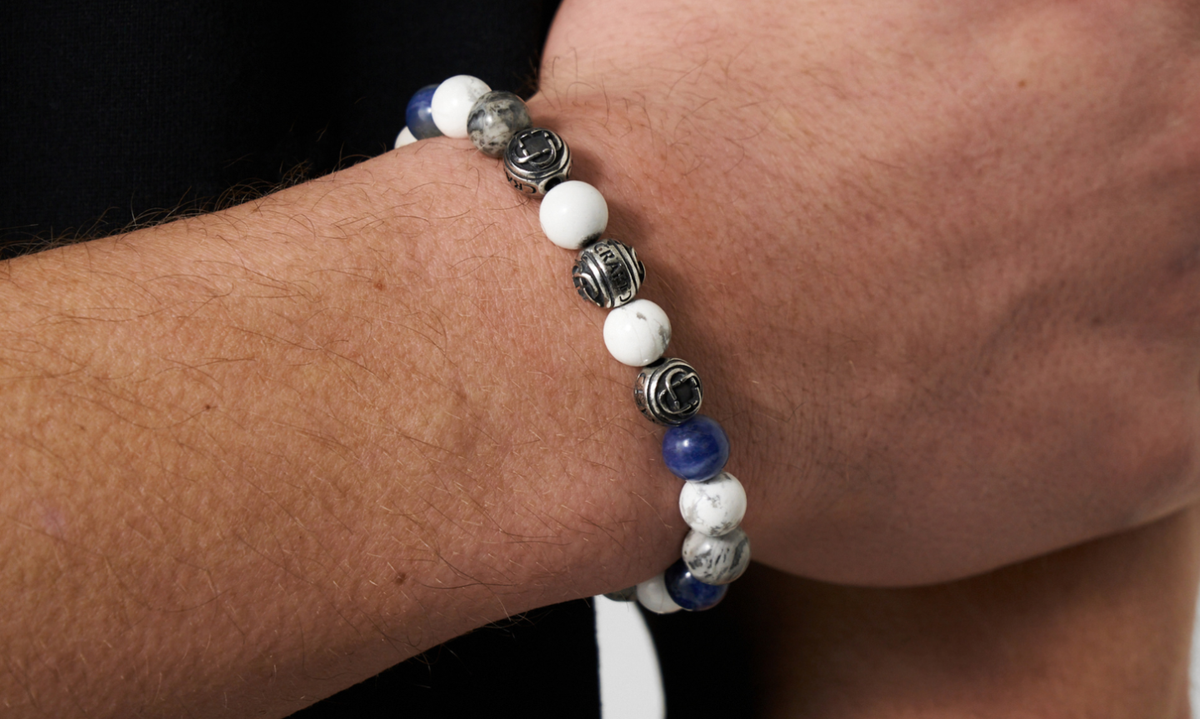
Howlite for Men: A Calm Stone for a Busy Life
Howlite is the quiet one: a white stone named in 1868 and often dyed to pass as turquoise. Here’s what it means, where it’s from, and how to wear a howlite bead bracelet well.
Read more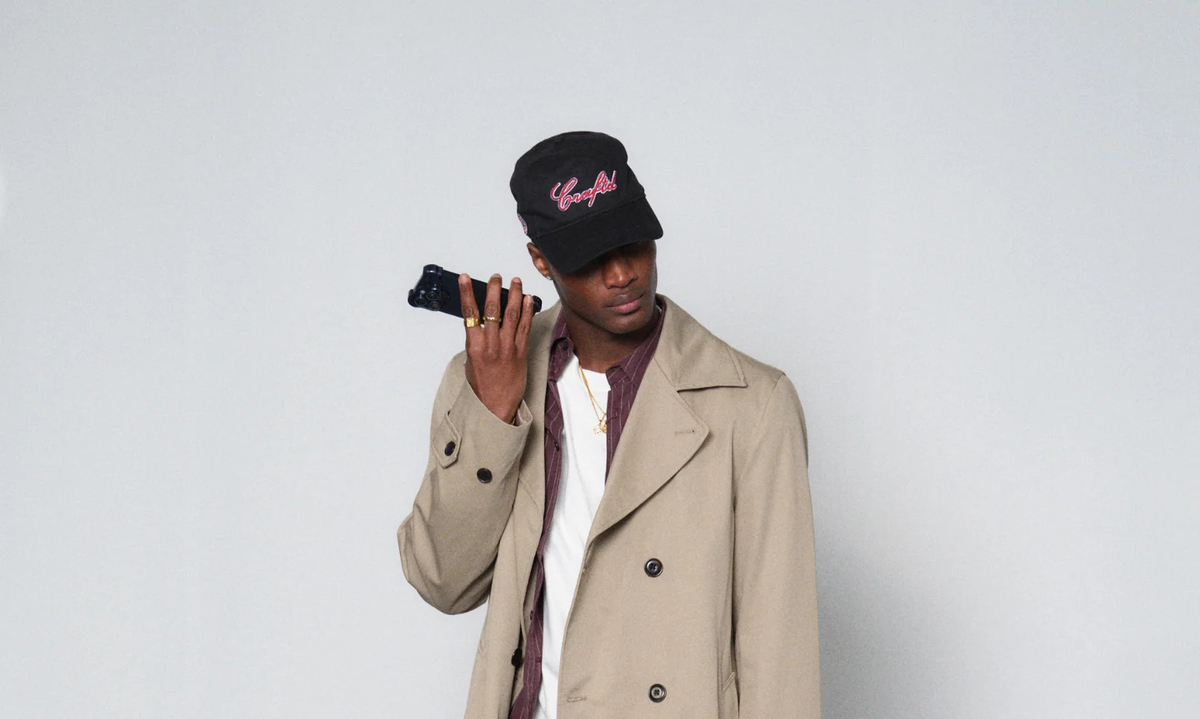
What makes a cap look broken in from day one, and how do you wear it without looking scruffy? Here’s how to fit, style and pair a distressed cap, from plain tees to fine chains.
Read more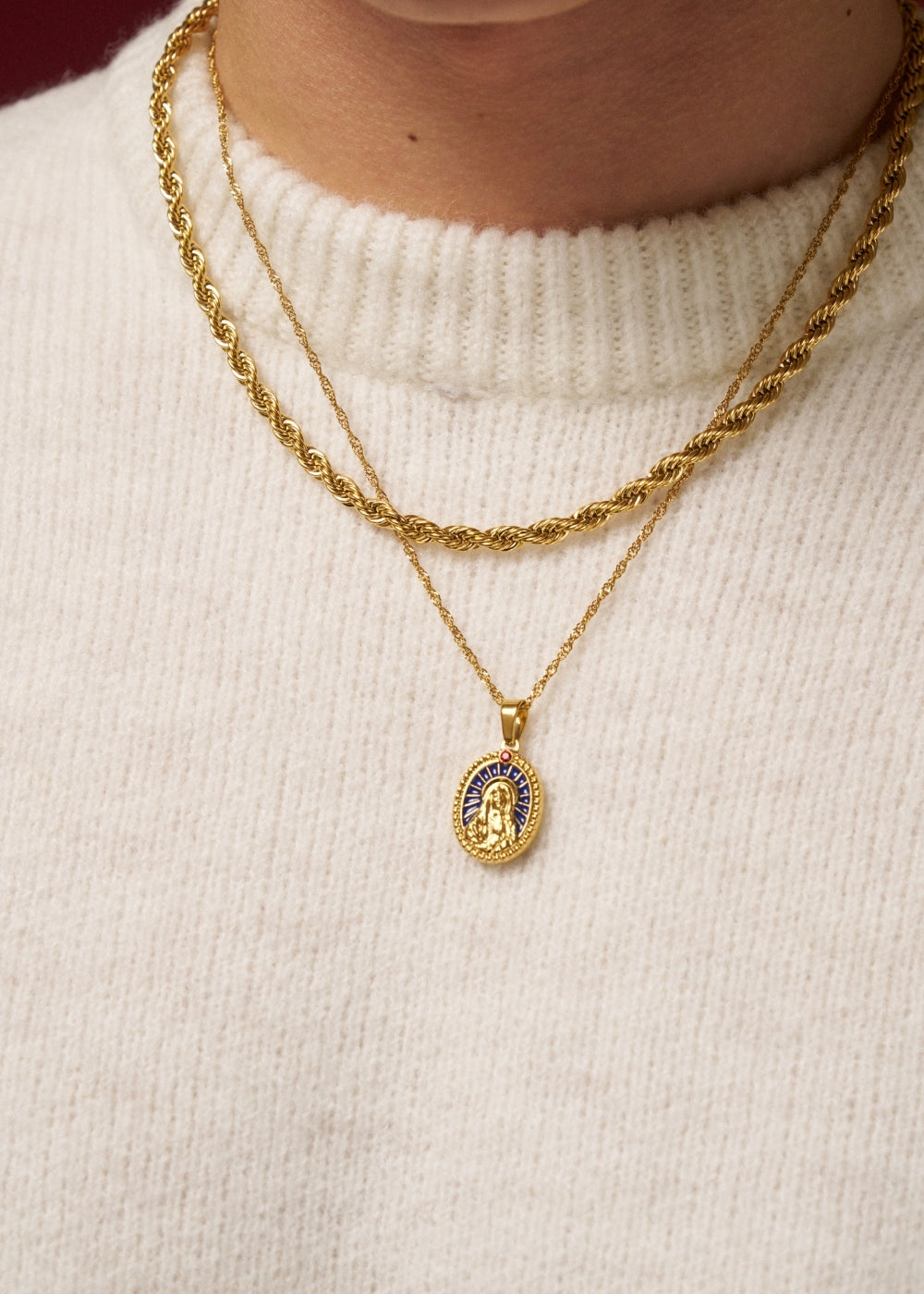

Leave a comment
This site is protected by hCaptcha and the hCaptcha Privacy Policy and Terms of Service apply.