



Cross vs Crucifix: What a Crucifix Necklace Really Means
Whether worn as a statement of faith, a family tradition, or a quiet reminder of what matters, the crucifix has been a constant around men's necks for centuries. Here's exactly what it means, how it differs from a cross, and how to find the one that's yours.
Jump to:
- What a crucifix actually is
- What's the difference between a cross and a crucifix?
- What does wearing a crucifix mean?
- Why men wear crucifix necklaces?
- The best types of men's crucifix necklaces
- Why a crucifix makes a meaningful gift
- FAQs
What is a crucifix?
A crucifix is a cross with the figure of Jesus on it. That figure, known as the corpus, is what separates it from every other cross you'll see. The word comes from the Latin crucifixus, meaning "fixed to a cross", and the symbol has been central to Christian worship since the early Middle Ages.

Featured: Men's Crucifix Collection
Where a plain cross points to an idea, the crucifix shows the moment itself. That's why it carries a different weight. It's not an abstract symbol of faith; it's a depiction of sacrifice. For the men who wear one, that's usually the point. It's a reminder of what was given, carried close, every day.
What is the difference between a cross and a crucifix?
A crucifix is a cross that carries the figure of Jesus, known as the corpus. A cross is the bare symbol on its own.

Featured: Crucifix (Gold)
The distinction matters more than it first appears, because the two symbols have come to represent slightly different emphases within Christianity. The crucifix focuses on the crucifixion itself, the sacrifice. It's most strongly associated with Catholic and Orthodox traditions, where it appears on altars, rosaries, and church walls. The empty cross emphasises what came after: the resurrection. That's why it became the more common symbol in Protestant churches, which historically moved away from religious imagery.
Neither is more "correct" than the other. Both are worn across many Christian denominations, and plenty of men choose between them on instinct rather than doctrine. If the fuller symbol speaks to you, it's the crucifix. If you prefer the cleaner, more open form, it's the cross.

You can explore our full cross and crucifix collection here.
What does wearing a crucifix mean?
A crucifix on a wall is devotional. A crucifix around your neck is personal. Wearing one takes everything the symbol holds, sacrifice, faith, endurance, and turns it into something you carry rather than something you visit.
For believers, that's usually an expression of faith worn close to the heart, and for many it doubles as protection: a tradition of wearing the cross as a spiritual shield that goes back centuries. For others, the meaning is quieter. It's a daily reminder that nothing worth having comes without sacrifice, and that whatever the day brings, there's something steady underneath it.

Featured: Iced Crucifix (Silver)
That's what separates a crucifix from almost everything else a man can put on. It doesn't decorate. It says something, whether or not anyone else hears it.
Why do men wear crucifix necklaces?
Ask ten men why they wear one and you'll get ten different answers. For some, it's active faith, worn the way it's been worn for generations. For others, it's heritage: a piece passed down, or a link to a grandparent who never took theirs off. And for many, it's something quieter. A value system, worn where only they know it's there.

Featured: Crucifix (Gold)
The crucifix has also travelled further beyond the church than almost any other symbol. It hung on stage through the pop and rock eras of the seventies and eighties. Hip-hop made the crucifix and the Jesus piece part of its visual language, worn heavy and worn proudly. Footballers tuck one under the shirt and kiss it after a goal. Boxers wear it into the ring. It shows up on fashion runways one season and in family photo albums going back four generations.

Featured: Men's Crucifix Collection
That reach says something. A symbol doesn't hold its place for two thousand years, and cross into every corner of culture, unless it carries real weight. The crucifix never became a trend, because it was never designed to be one. It just kept meaning something, to whoever picked it up.
How did the crucifix become a symbol of faith?
Here's the part most people don't know: for the first few centuries of Christianity, the cross was not yet the everyday symbol we recognise now.
It's easy to forget what the cross was at the time. Not a symbol. An execution device, still in use across the Roman Empire, and about as raw an image as a believer could carry. So early Christians identified each other differently, most famously with the fish. The cross was the thing their faith had survived, not yet the thing that represented it.

Featured: Crucifix (Gold)
The change came gradually. As early as 200 AD, the writer Tertullian was describing Christians tracing the sign of the cross over their daily lives. The symbol was already central; it just hadn't yet become something to wear. Then, after Christianity was legalised under Constantine and crucifixion fell out of Roman use, the cross could begin to carry a different meaning. No longer the empire's instrument of punishment, it slowly became its most recognisable image of hope.
The crucifix, the cross with the corpus, followed. It began appearing in Christian art around the fifth and sixth centuries. From there, the image spread through churches and devotional art. Over the centuries that followed, it also became something personal: worn as a pendant, carried in prayer, and eventually passed through families. By the Renaissance, goldsmiths were producing finely detailed crucifixes that became heirlooms, handed from father to son.

Featured: Melted Crucifix (18ct Gold)
Which, if you think about it, is still how it works. Most crucifixes don't get bought on a whim. They arrive as gifts, mark a moment, and outlast the person who gave them.
What are the best types of men's crucifix necklaces?
The Crucifix has been part of CRAFTD from the early days, and it remains one of the most-worn pendants we make. Our take keeps the detail where it matters, in the corpus and the finishing, and strips away everything else. No excess ornament. Just the symbol, made to be worn daily and built to hold up when it is. Every piece is finished with our signature scratch and fade-resistant protection, so the piece he puts on today looks the same in five years. You'll find them all in our crucifix collection.
Men's Gold Crucifix Necklace
The original. Worn close, worn daily. Our classic Crucifix in Gold carries a fully detailed corpus on a clean, weighted cross, sized to sit naturally on the chest without shouting. It's the piece for the man who wants the full symbol, worn the traditional way, in triple-coated 18K gold over a solid core. Also in Silver.

Men's Gold Vermeil Crucifix Pendant
The traditional form, reshaped. The Melted Crucifix softens the hard lines of the classic silhouette into something more sculptural, closer to a piece of art than a standard pendant. Cast in sterling silver or 18ct gold vermeil, it's for the man who wants the symbol on his own terms. Familiar from a distance, unmistakably different up close. Also in Sterling Silver.

Mini Crucifix Pendant
The same symbol, scaled back. The Mini Crucifix takes everything the classic carries and refines it into a smaller, subtler pendant. It sits closer to the collarbone, works under a shirt without printing through, and layers cleanly with a second chain. The right choice for the man who wants the meaning without the presence. You can buy it on its own, or as part of our best-selling Jesus & Mary pendant. Also in Silver.


Men's Silver Crucifix Necklace
The same original, in a cooler tone. The Crucifix in Silver carries the same fully detailed corpus on a clean, weighted cross, on a solid steel core. It's the everyday choice for the man whose watch, rings, and chains already run silver, and it takes the same scratch and fade-resistant finish as the rest of the collection.

Men's Iced Crucifix Necklace
The symbol, with light behind it. The Iced Crucifix sets hand-placed stones across the cross, framing the corpus in shine. It's the most expressive piece in the collection, made for the man whose faith and style occupy the same space. Despite the finish, the build is the same underneath: solid construction, secure settings, and protection that keeps the stones where they belong. Also in Gold.

Men's Crucifix Rosary Bead Necklace
Two traditions on one chain. The Crucifix Rosary Bead Necklace pairs the crucifix with traditional rosary beads, bringing together two of the oldest forms in men's jewellery. The beads soften the piece; the crucifix grounds it. It's a combination that reads considered rather than loud, and it's become a favourite for men building a rotation beyond a single everyday chain.
Should you choose a silver or gold crucifix?
Once you've found the design, the remaining question is metal.
Gold is the traditional choice. It's the metal of church iconography, of heirloom pieces, of the crucifix your grandfather wore. It reads warm, classic, and a little more deliberate. Our gold pieces are triple-coated in 18K gold over a solid core, with the Melted Crucifix also available in 18ct gold vermeil for those who want the precious metal all the way through.

Featured: Crucifix (Gold)
Silver is the quieter route. Cooler against the skin, easier to pair with everything else in a modern wardrobe, and less expected. Our silver crucifixes come in polished silver and stainless steel builds depending on the piece.
There's no wrong answer here. Most men choose whichever metal already runs through their watch, their rings, or the chains they own. If you're buying as a gift and don't know, look at what he wears now. The metal he's already living in is the metal to buy.

How should men wear a crucifix necklace?
The crucifix is one of the easiest pendants to wear, because it never looks like a trend. A few ways in:
- Solo on a Cuban or Rope chain. The classic. A 3mm chain keeps the pendant the focus.
- Layered with a plain chain. Crucifix on the longer chain, a clean Cuban above it. Two lengths, no clutter.
- Under the shirt. The Mini Crucifix disappears under a collar and sits against the skin. Worn for him, not for anyone else.
- With other meaningful pendants. A crucifix pairs naturally with a Saint Christopher or a Cross of Lorraine on separate chains, kept at different lengths. Our guide to men's religious pendant meanings covers the full line-up.

Featured: Men's Crucifix Collection
Silver reads cooler and quieter; gold reads warmer and more traditional. Neither is wrong. Most men choose whichever metal already runs through the rest of their pieces. If you're weighing up chain styles more broadly, our guide to every type of men's chain walks through the options.
Getting the length right
Length changes how the piece reads more than most men expect:
- 20 inches sits at the collarbone. The right call for the Mini Crucifix and for anyone wearing it under a shirt.
- 22 inches is the default. Mid-chest, visible in an open collar, comfortable all day. If in doubt, this is the one.
- 24 inches and up drops the pendant lower. Best for layering, where the crucifix takes the longest chain and a plain chain sits above it.

If he's building something personal, our Build Your Own Pendant lets you start with a large or mini crucifix and add up to two mini pendants or gemstone charms, with over 300 combinations. A piece that's his and no one else's, whether you're wearing it yourself or gifting it.
Why does a crucifix make a meaningful gift?
A crucifix is one of the few gifts that says something without you having to.
For a father, a brother, a son, or a partner, it marks faith, protection, and connection in a single piece. If you want the gift to arrive complete, the Crucifix Set and Crucifix Gift Set pair the pendant with a matching chain, ready to wear from the box. For something that carries both figures of the tradition, the Jesus & Mary pendant set is the natural step up.

How to care for a crucifix necklace
A crucifix earns wear, and wear earns marks. Ours are built for it: the scratch and fade-resistant coating handles daily life, showers included. Beyond that, an occasional wipe with a soft cloth keeps the detail in the corpus crisp.
Crucifix FAQs
What is the difference between the crucifix and the empty cross?
A crucifix includes the figure of Jesus (the corpus); an empty cross doesn't. The crucifix emphasises the sacrifice of the crucifixion, while the empty cross is often read as a symbol of the resurrection. Both are worn across many Christian denominations.
What is a crucifix used for?
Beyond jewellery, crucifixes are used in prayer, worship, and devotion, particularly in Catholic and Orthodox practice, where they appear on rosaries, altars, and in homes. Worn as a necklace, a crucifix is typically a personal expression of faith, remembrance, or protection.
When did the crucifix become a necklace?
Crosses appear as personal ornaments from the early medieval period, and wearable crucifixes became established gradually over the centuries that followed, from devotional pendants and rosaries to the finely detailed heirloom pieces made from the Renaissance onwards.
Why do some Christians not like the crucifix?
Some Protestant traditions historically moved away from religious imagery, preferring the empty cross as a symbol of the resurrection rather than a depiction of the crucifixion. It's a difference of emphasis rather than a dispute over the symbol's meaning, and attitudes vary widely between churches and individuals.
Is it wrong for a Catholic to wear a cross instead of a crucifix?
No. The Catholic Church doesn't require the faithful to wear a crucifix rather than a cross. The crucifix is more traditional within Catholic practice, but a plain cross worn in faith carries the same intent. It comes down to personal preference.
Can I wear a crucifix if I'm not Catholic?
Yes. The crucifix is most strongly associated with Catholicism, but it's also part of Orthodox, Anglican, and Lutheran tradition, and Christians of many denominations wear one. It's a symbol of the faith as a whole, not of one branch of it.
Can I wear a crucifix if I'm not religious?
That's a personal call. Plenty of men wear one for heritage or family connection rather than active practice. What we'd say is this: it's a symbol that means a great deal to a lot of people, so it tends to sit best on men who wear it with some connection to what it represents.
Is it disrespectful to wear a crucifix as fashion?
There's no rule against it, and the crucifix has lived in fashion for decades. Most people would say intent is what matters: worn with some awareness of what the symbol means, it reads as respect rather than costume. Worn purely as decoration, some believers may see it differently, so it's worth knowing what you're carrying.
What does an upside-down cross mean?
In Christian tradition, a plain upside-down cross is associated with Saint Peter, who is traditionally believed to have been crucified upside down. In modern popular culture, an inverted crucifix is sometimes used as an anti-Christian image, so its meaning depends heavily on the design and context.
What chain should I wear a crucifix on?
A 3mm Cuban or Rope chain is the classic pairing: strong enough to carry the pendant, clean enough to keep it the focus. Go 2mm for the Mini Crucifix, and up to 5mm if you want the whole piece to have more presence.
Find the one that's yours
The crucifix has meant something for two thousand years. Whatever it means to you, whether that's faith, family, or a reminder you keep close, there's a version in the collection that will carry it properly.

You can explore the full crucifix collection here.

Your next reads
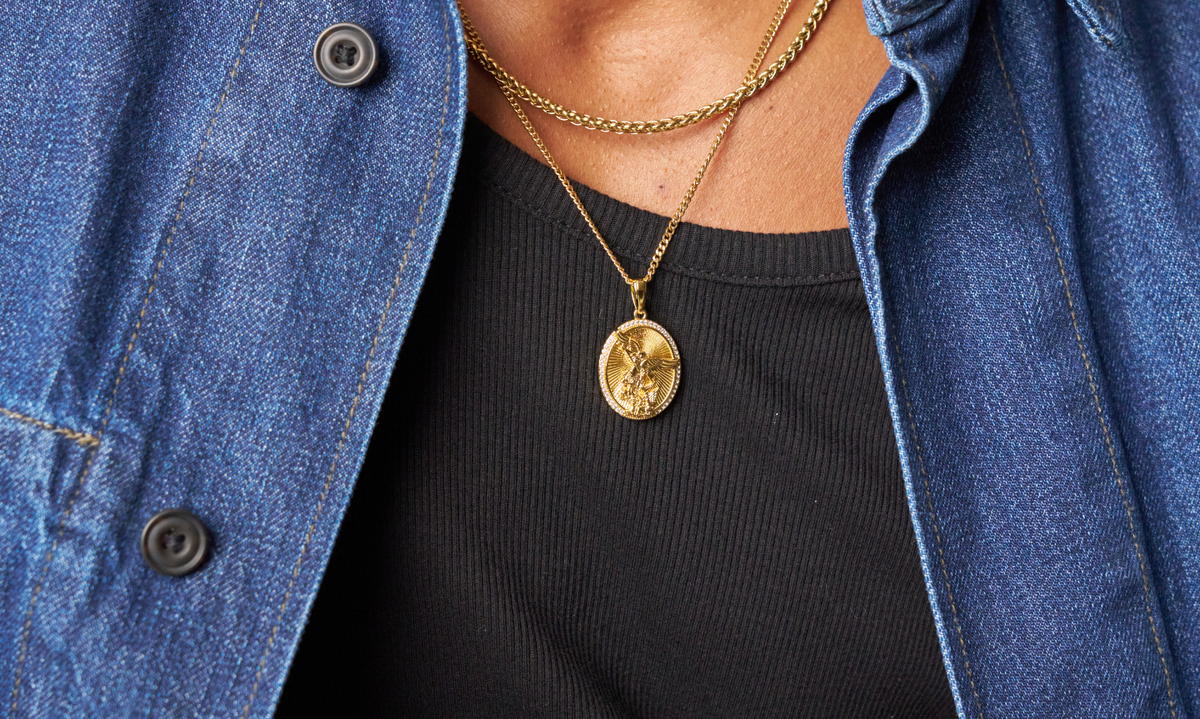
What Does Wearing a St. Michael Pendant Mean?
Who is Saint Michael, and why do so many men wear him for protection? Here’s the legend behind the archangel, and how to choose yours in silver, gold, or rose gold.
もっと見る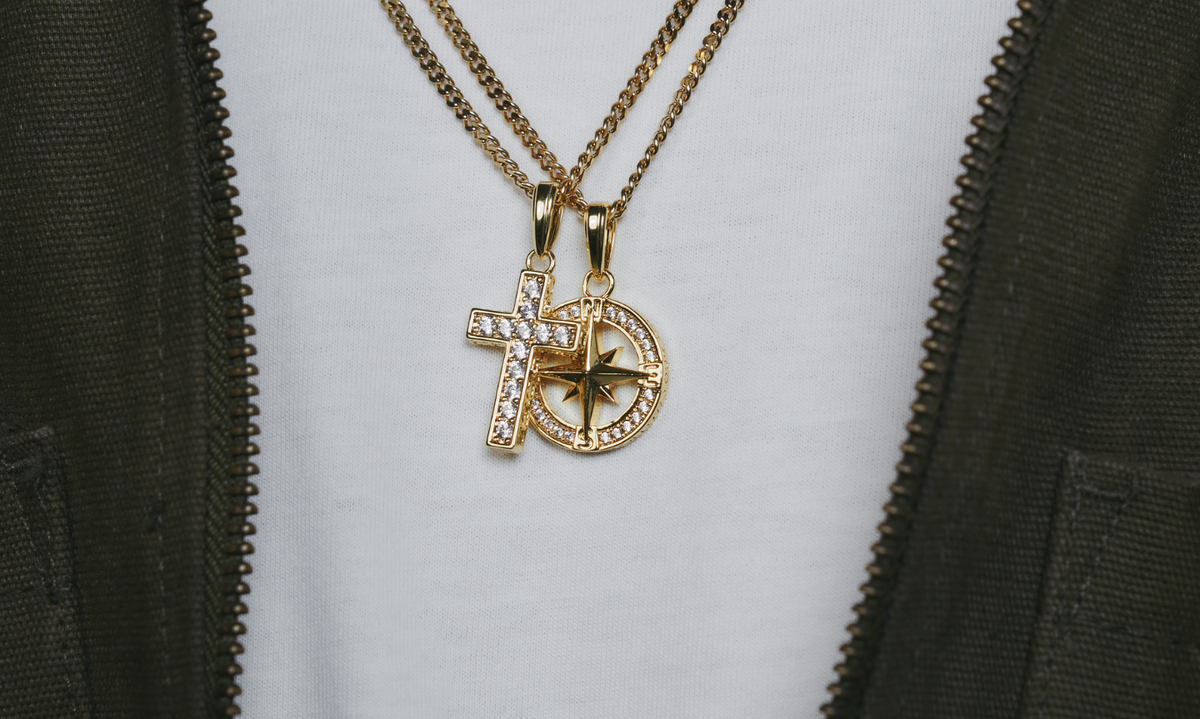
Why Men Wear Cross Necklaces and What They Mean
For some men, the cross is faith. For others, it’s family, endurance, protection or something only they understand. However it’s worn, it remains one of the most personal symbols a man can keep close.
もっと見る
コメントを書く
このサイトはhCaptchaによって保護されており、hCaptchaプライバシーポリシーおよび利用規約が適用されます。