GEMSTONES
SHOP NOW


Cart
Your cart is empty
Your gifting options
Make your gift extra special with our luxury packaging options. Select a gift bag, gift box or a combination to create the perfect presentation.

Luxury Gift Box, Gift Bag & Wrapping Kit (¥1,800)
Includes: CRAFTD Luxury Gift Box, Gift Bag, Tissue Wrapping Paper & Ribbon

Meaning Card (¥500)
Add more meaning to your gift with a meaning card included with your order.
15 variations available

Gift Bag, Ribbon & Wrapping (¥1,100)
Ideal for items that already include a gift box.
Includes: Premium CRAFTD Gift Bag, Ribbon & Tissue Wrapping. Doesn’t include: Luxury Gift Box.

Luxury Gift Box (¥1,100)
Present your gift in our signature gift box, designed to impress before it’s even opened.
Includes: Premium gift box
Choose your option
To My Boyfriend

To My Husband

To My Soulmate

To My Son

To My Grandson

To My Brother

To My True Friend

To My Dad

A Symbol Of Strength

A Symbol Of Faith

A Symbol Of Protection

A Symbol of Luck

A Symbol Of Safe Travel

A Symbol Of Adventure
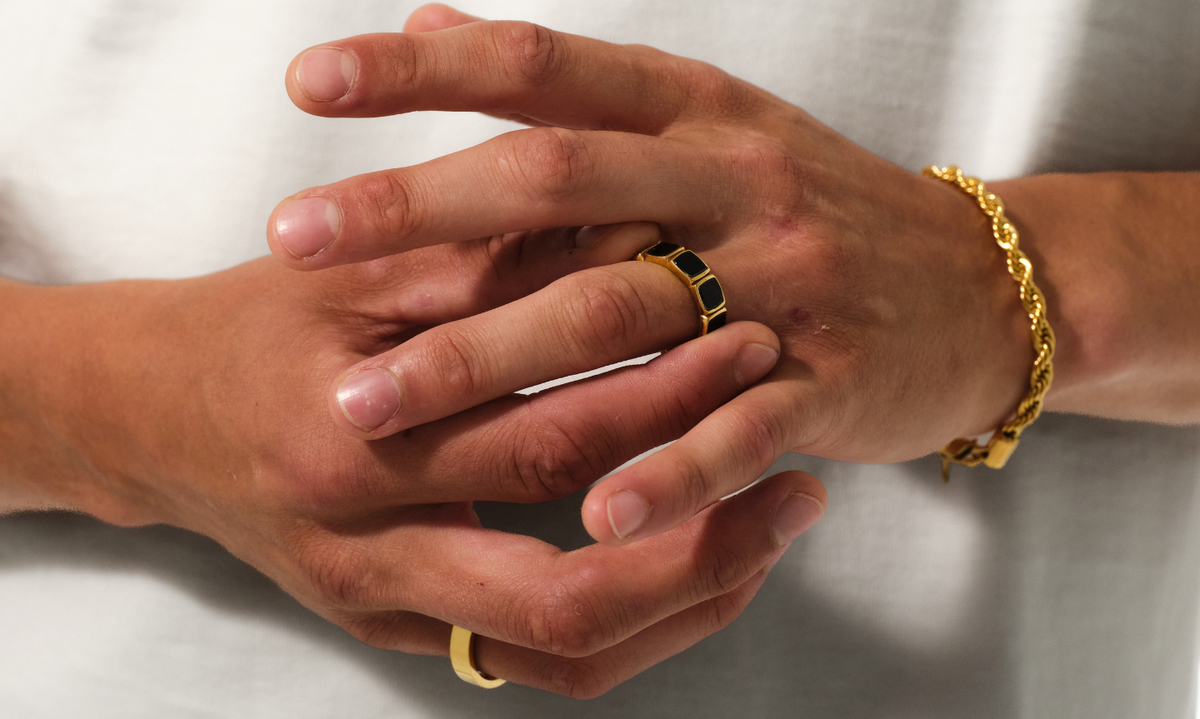
Gold rings need a slightly gentler hand than silver or steel, mainly because "gold" can mean several different things depending on the piece. Get the method right for yours and a clean takes five minutes. Get it wrong and you can dull a finish that should have lasted for years.
Here's exactly how to clean each type of gold ring, including solid gold, and how to tell which one you own. If it's not just rings you're cleaning, our guide to cleaning gold jewellery covers every type there is.
Jump to:
18K gold vermeil is real gold, bonded in a proper thickness over a solid sterling silver base. It's the closer of the two to fine jewellery, and it ages a little like it too, developing character over years of wear rather than staying static.
Gold-plated stainless steel is our everyday range, a steel core finished in 18K gold with rhodium underneath for extra durability. It's built specifically for daily wear: gym, showers you forget to take it off before, the lot. The trade-off is that the gold layer itself is thinner than vermeil, so it still deserves a gentler clean than the steel underneath would suggest.

Not sure which one you've got? Check the product page. If it says "gold vermeil," treat it like the softer, more precious piece. Everything else in our rings range that isn't marked vermeil, sterling silver, or tungsten is gold-plated stainless steel. For the full breakdown of how each is actually made, our 18K gold vs gold vermeil guide covers it in more depth. If you want the numbers behind the word "plated" before you buy anything else, what gold plated actually means breaks down the thickness standards.
Solid gold is the third possibility, and it isn't something we make. If your ring is a wedding band, an heirloom, or anything carrying a hallmark on the metal itself, it's gold all the way through with no finish to wear off. That one is the most forgiving of the three, and it has its own section below.
Fill a bowl with cold or lukewarm water, never hot, and add a couple of drops of mild dishwashing liquid. Let the ring sit for a minute or two, then use a soft cloth rather than a brush to gently work over the surface. A toothbrush is fine for solid gold but can be too much for a vermeil layer, so keep the pressure light. Rinse under running water and pat dry immediately with a soft, lint-free cloth. Don't let it air dry, since sitting wet can dull the silver base underneath the gold.

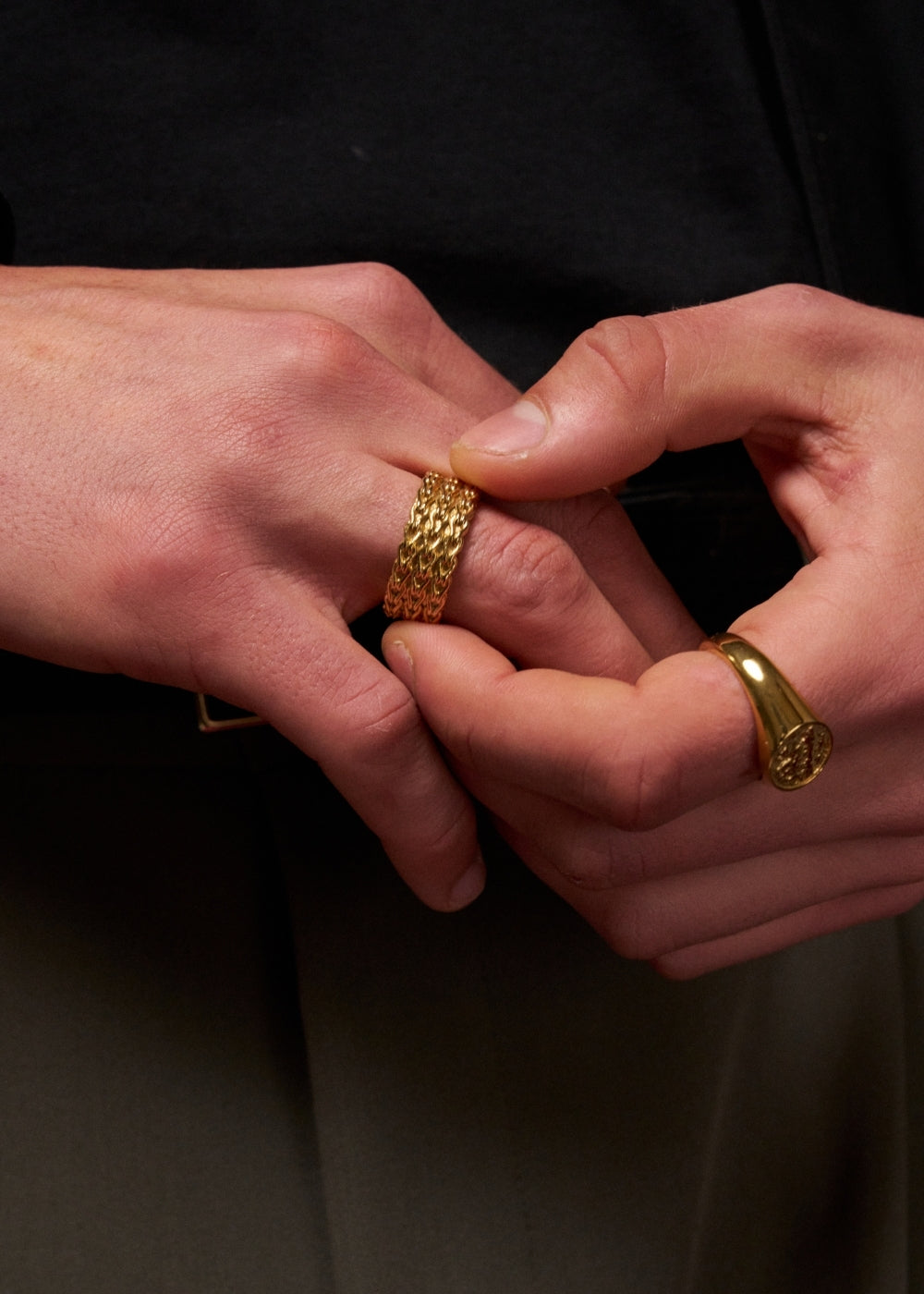
Featured Ring: Enamel Virgin Mary Signet Ring (Gold)
The steel core gives you a bit more room to work with. Soak the ring in warm water with a few drops of mild dish soap for around 15 to 20 minutes to loosen any build-up, then use a soft-bristle toothbrush to clean gently around any engraved detail or signet face. Rinse thoroughly and dry with a soft cloth straight away. It's more forgiving than vermeil, but the plating is still thinner than solid gold, so stick to gentle pressure rather than heavy scrubbing. For anything plated that isn't a ring, cleaning gold-plated jewellery goes further into telling build-up apart from plating that is genuinely wearing.

Featured Ring: Square Signet Ring (Gold)
If your ring is solid gold, a wedding band or an inherited signet rather than something plated, you have the easiest job on this page. There's no finish to wear through and no base metal hiding underneath, so what you see is what the ring is made of all the way down.
Warm water, a few drops of mild washing-up liquid, and a ten to fifteen minute soak. A soft-bristle toothbrush is genuinely fine here, worked gently around any engraving or setting. Rinse under running water and dry with a soft cloth. You can repeat this as often as you like without consequence, which isn't true of the other two.
The part almost nobody cleans is the inside of the band. It sits against skin all day, it never gets wiped, and on a ring worn continuously for years it holds more than the whole outer surface combined. Work the brush around the inner face specifically, and pay attention to the seam where a band meets a signet face or a setting.
Two things to respect. Gold gets softer as the carat rises, so an 18K band scratches more easily than a 9K one. Keep the pressure light and store it where it won't knock against tungsten or steel. And lower carats can dull very slightly over years. That's the alloy metals reacting rather than the gold, which doesn't tarnish at all, and a soapy soak brings it back.
If the ring has a stone in it, keep the stone out of the soak and wipe it separately with a dry cloth. Softer and more porous stones don't want to sit in water, and a setting doesn't want to be worked at. If you're not sure what you're holding, the hallmark will tell you: a British assay mark carries the fineness alongside the sponsor's mark, so 750 is 18 carat, 585 is 14 and 375 is 9.
Everything above assumes a plain band or a solid signet face. The moment a ring has a stone in it, the metal stops being the thing you need to worry about and the setting takes over.
Work out how the stone is held before you put the ring anywhere near water. If you can see prongs gripping the stone, or a raised metal rim running around its edge, it is set mechanically and a short soak will not shift it. If the stone sits flush with no visible prongs or rim, assume it is glued, and keep it out of the water entirely. Adhesive gives up long before metal does, and a soak is the fastest way to find that out the hard way.
For a glued or unknown setting: a barely damp cloth, a soft-bristle toothbrush worked around the outside of the setting rather than into it, and dry it immediately. For a prong or bezel setting on a hard stone, you can use the normal method, but keep the soak short and never leave it sitting.
The cloudiness is almost always behind the stone, not on it. On a raised setting, skin oils and soap residue collect underneath where nothing reaches, and that is what dulls the sparkle rather than anything on the visible face. A soft brush angled up from below the setting does more than any amount of polishing the top.
Some stones want more care than others. Onyx, turquoise, opal, pearl and coral are soft, porous or both, and none of them wants a long soak, an acidic cleaner or an ultrasonic bath. Onyx in particular can dull if it sits in soapy water, so wipe it rather than submerge it. Harder stones like sapphire and cubic zirconia are far more forgiving. Our onyx rings and the wider gemstone range all sit in the wipe-rather-than-soak camp.
And leave ultrasonic cleaners alone on anything set, whatever the stone. The vibration is what loosens a setting, and that applies to a prong just as much as to glue.
Skip chlorine, bleach, and anything abrasive, including baking soda paste, which works well on solid silver but is too rough for a plated gold surface. Toothpaste has the same problem: it's a popular myth, but it's genuinely abrasive enough to leave fine scratches on gold. Ultrasonic jewellery cleaners are worth avoiding too, since the vibration can work gold plating loose over time. When in doubt, mild soap and a soft cloth will always be the safer call over anything marketed as a stronger clean.

Featured Ring: Saint Benedict Band Ring (Gold)
Take gold rings off before swimming, showering, and the gym. Chlorine and prolonged sweat exposure are the two biggest causes of a plated finish wearing thin before its time. Let any perfume, aftershave, or hand cream dry completely before putting rings back on, since the chemicals in both can dull gold faster than daily wear alone. If your ring is part of a wider ring stack, our full guide to cleaning every ring material covers sterling silver and tungsten care too.
Whether you're after the real thing or our everyday gold-plated range, here are three worth a look.

Featured Ring: Round Band Ring (Gold)
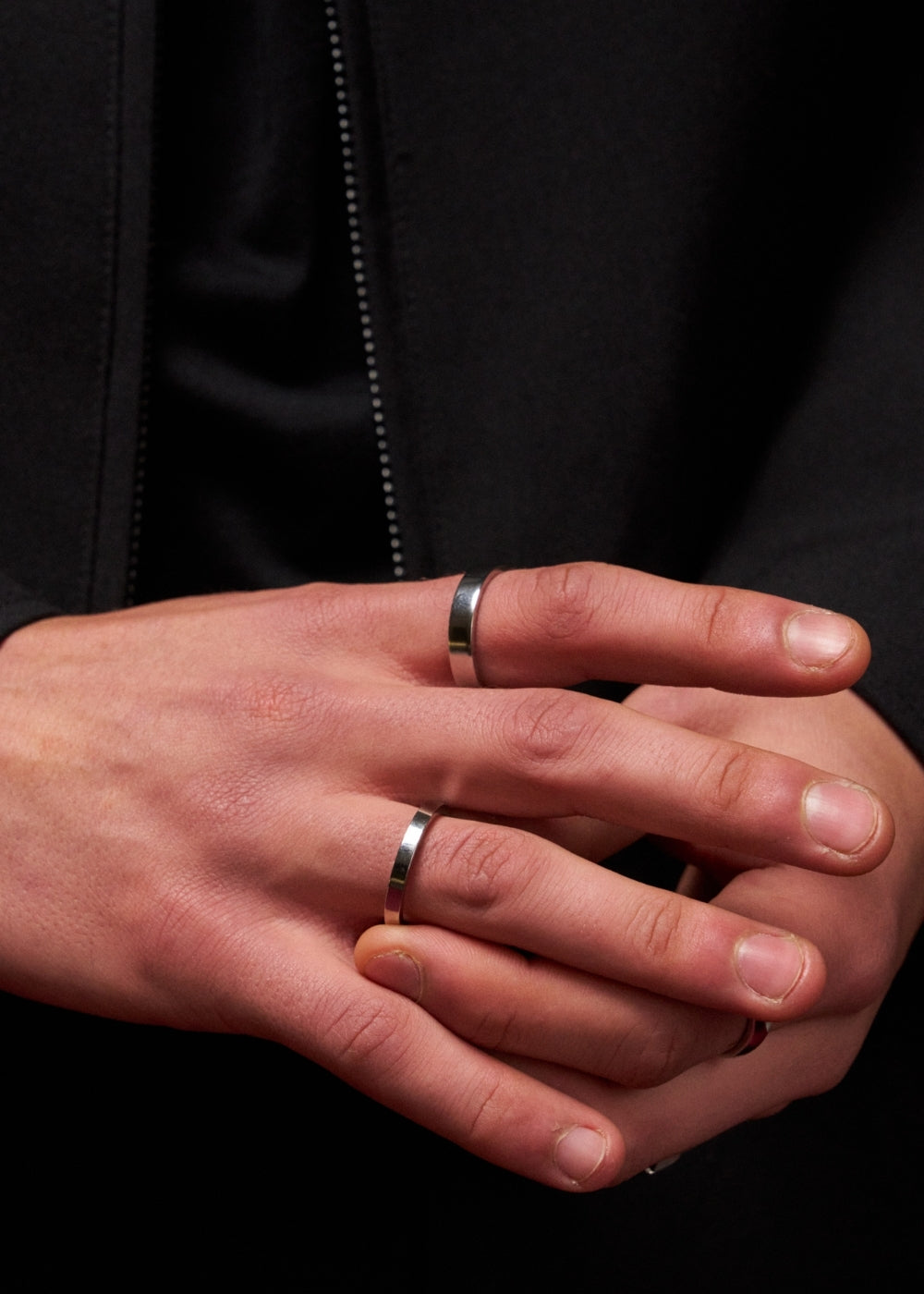
A smooth 5mm band with a high-polish finish, designed for everyday wear, solo or stacked with the rest of your rotation. See the full band rings collection here.

Featured Ring: Bevelled Ring (18ct Gold Vermeil)
Handcrafted from sterling silver and rich 18K gold vermeil, with a bevelled outer edge and a brushed finish that wears effortlessly alone or stacked. See the full sterling silver rings collection here.

Featured Ring: Enamel Swallow Signet Ring (Gold)
An 18K gold signet featuring a swallow in flight on rich blue enamel, carrying a single rose set with a natural red gemstone. See the full signet rings collection here.
Gold vermeil is real gold bonded over a solid sterling silver base. Gold-plated stainless steel uses a steel core finished in gold with rhodium underneath. Vermeil is the more precious of the two; gold-plated stainless steel is built for tougher daily wear.
Warm water, mild washing-up liquid and a fifteen minute soak, then a soft-bristle toothbrush worked gently over it, including the inside of the band. That inner surface sits against skin all day and never gets wiped, so on a ring worn for years it holds more than the entire outside does. Rinse well and dry with a soft cloth. Solid gold has no finish to wear through, so you can do this as often as you like.
Carefully, and usually without soaking it. A statement ring is mostly setting rather than metal, so the risk sits in what is holding the stone. If you can see prongs or a raised rim around the stone it is set mechanically and a short soak is fine. If the stone sits flush with nothing visible holding it, assume it is glued and use a barely damp cloth instead. Either way, work a soft brush around and underneath the setting rather than across the top, because the residue that dulls a stone collects behind it. Dry it immediately, and keep it out of an ultrasonic cleaner, which loosens settings of every kind.
Any plated or vermeil piece can show wear eventually, usually after years of daily contact. Gentle cleaning and taking rings off before swimming or the gym will slow this down considerably.
It's best not to. Soap residue and prolonged water contact can dull the finish faster than normal wear, so it's worth building the habit of taking it off first.
With proper care, our gold-plated stainless steel pieces are built to resist fading for years of regular wear. How long any plated piece lasts comes down to how it's cleaned and how often it's exposed to water, sweat, and chemicals. Our full breakdown on gold-plated jewellery lifespan goes into more detail.
We'd avoid it. Most shop-bought jewellery cleaners are formulated for solid gold and can be too harsh for a vermeil layer. Mild soap and water is the safer, and just as effective, option.
Real gold or gold-plated, both are built to earn their place in daily rotation when they're looked after properly. Browse the full range here.
How Much Does it Cost To Resize a Ring?
Ring feeling loose, or sliding past your knuckle? Here's how to tell for sure, what it costs to resize (when that's even possible), and what to do if the size just isn't right.
Read more
Wondering what makes a chain a curb chain? Flattened, twisted links that lie flush against the neck. A full guide covering the types, widths, styling, care, pendants to pair, and the CRAFTD Cali.
Read more

Leave a comment
This site is protected by hCaptcha and the hCaptcha Privacy Policy and Terms of Service apply.