GEMSTONES
SHOP NOW


Cart
Your cart is empty
Your gifting options
Make your gift extra special with our luxury packaging options. Select a gift bag, gift box or a combination to create the perfect presentation.

Luxury Gift Box, Gift Bag & Wrapping Kit (£7.99)
Includes: CRAFTD Luxury Gift Box, Gift Bag, Tissue Wrapping Paper & Ribbon

Meaning Card (£1.99)
Add more meaning to your gift with a meaning card included with your order.
15 variations available

Gift Bag, Ribbon & Wrapping (£4.99)
Ideal for items that already include a gift box.
Includes: Premium CRAFTD Gift Bag, Ribbon & Tissue Wrapping. Doesn’t include: Luxury Gift Box.

Luxury Gift Box (£4.99)
Present your gift in our signature gift box, designed to impress before it’s even opened.
Includes: Premium gift box
Choose your option
To My Boyfriend

To My Husband

To My Soulmate

To My Son

To My Grandson

To My Brother

To My True Friend

To My Dad

A Symbol Of Strength

A Symbol Of Faith

A Symbol Of Protection

A Symbol of Luck

A Symbol Of Safe Travel

A Symbol Of Self Belief

A Symbol Of Adventure

Everything you need to clean a gold chain properly is already in your kitchen, and it costs about four pence.
The complication comes from everywhere else. Search this question and you'll be told to mix ammonia with hydrogen peroxide, to dip the chain in boiling water, to scrub it with toothpaste or to soak it in a jewellery solution bought for the purpose. Some of those do nothing. The rest will cost you the finish, and on a plated chain that damage is permanent.
A chain is also not a flat piece of jewellery, which is the part most guides ignore entirely. It's dozens of moving links, a clasp with a spring inside it, and in some styles an enclosed cavity in every single link. That changes where the dirt goes and how you get it out.
Below: the method, the clasp, how the style of your chain changes things, and the two popular techniques worth actively avoiding.
Jump to:
That's the entire list. You don't need a jewellery cleaning solution, and on a plated chain most of them are too strong anyway, since they're formulated for solid gold and stones.
One thing worth adding if you have it: a sieve or a colander to rest the chain in while you rinse. Chains and plugholes have a long history.
The drying step is the one people skip and the one that causes the most damage. Water trapped between links and inside a clasp is the single most common cause of a chain looking dull again a week after you cleaned it.
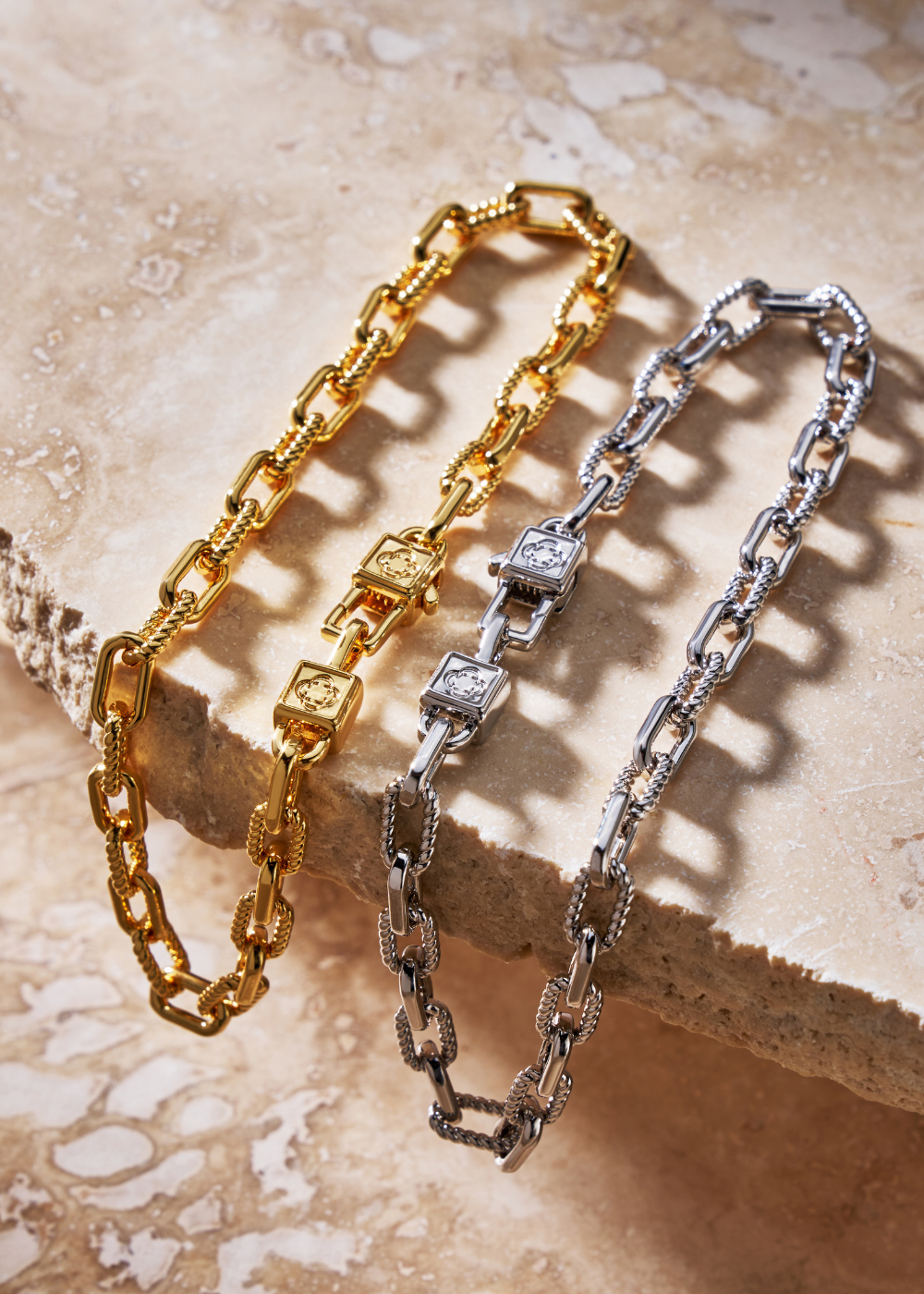
Think about where a clasp sits. It's at the back of your neck, under your collar, in the warmest and least ventilated part of the whole piece. It has a spring mechanism with an internal cavity. It's the part your fingers touch every single day.
It collects more than the rest of the chain combined, and almost every cleaning guide treats the chain as one uniform object and never mentions it.
Keep it submerged and work the toothbrush into the opening of the clasp from a few angles. Then open and close the mechanism ten or fifteen times while it's underwater, which flushes the inside of the spring housing in a way that no amount of brushing at the outside will.
Rinse it with the clasp open. Dry it with the clasp open too, and give it longer than the rest of the chain, since the cavity holds water.
If a clasp has become stiff or gritty to operate, that's usually dried residue inside the spring rather than a fault. A proper soak and the open-close flush fixes most of them. If it's still stiff after drying, or if it doesn't spring back firmly, stop wearing it until it's looked at. A clasp that fails is how a chain gets lost.
Same method for both. Different tolerances, and it's worth knowing which you have before you decide how firm to be.
Solid gold is forgiving. There's no finish to wear through, so a soft brush is genuinely fine and you can repeat the clean as often as you like. The only thing to respect is that gold softens as the karat rises, so an 18K chain scratches more easily than a 9K one.
Gold plated is not forgiving, and the margin is thinner than most people picture. A plated chain is a base metal with a layer of gold bonded over it, and that layer is measured in microns rather than millimetres. Every abrasive pass takes a little of it. There's no wearing it in, and once it's through, re-plating costs more than most chains are worth. Our guide to what gold plated actually means covers the two numbers that decide whether a plated piece is worth owning.
So on a plated chain: soft cloth first, toothbrush only where you need it, light pressure throughout, and nothing abrasive at any point.
Ours sit in this category and are built for it. Each chain is a solid 316L stainless steel core finished in real 18K gold, with a rhodium layer beneath the gold and an anti-tarnish seal over it. The steel core doesn't rust, corrode or tarnish, which is why these handle daily wear better than a soft precious metal would. The gold on top is still a finish, and it still wants a gentle hand.
Not sure which you own? Check the clasp or the tag for a carat stamp, and check the product page if you bought it recently.
This is the part that makes cleaning a chain different from cleaning a ring, and it's why two people can follow the same instructions and get different results.
| Chain style | How it's built | How to clean it | What goes wrong |
|---|---|---|---|
| Cuban and curb | Flat interlocking links, relatively open | Easy. Soak and wipe, the flat faces do most of the showing | Dulling across the flat surfaces rather than trapped dirt |
| Rope | Many small strands twisted around each other | Hardest. Soak longer, let the water do it, don't force a brush in | Residue packed between the strands |
| Box | Square links with an enclosed cavity in each one | Soak. Brushing the outside does nothing for the inside | Dirt sitting inside the boxes where you can't see it |
| Franco | Tight V-shaped links, very dense | Soak, then flex it gently under water to move the links | Build-up locked between links that barely move |
| Figaro | Alternating long and short links | Straightforward, but check where the link sizes change | Residue at the junctions between long and short links |
| Snake | Smooth and fully enclosed | Easiest to wipe, but never bend or kink it | A permanent kink, which cleaning cannot undo |
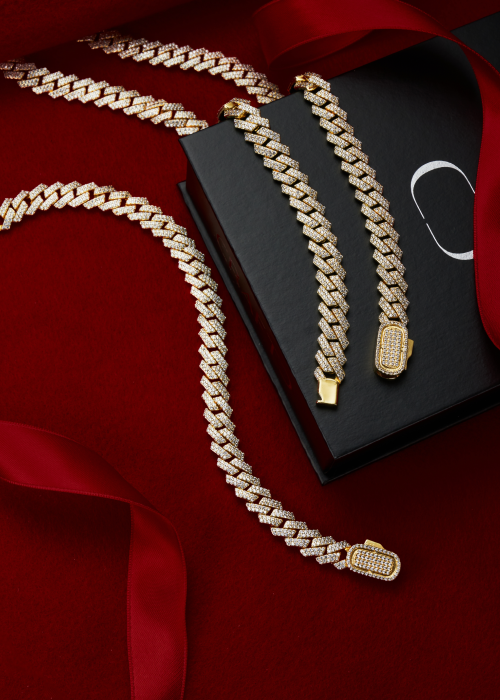
| Tennis | A row of set stones in individual settings | Wipe, don't soak. Each setting is a trap and some are glued | Cloudiness behind the stones, which is the hardest to reach |
The pattern: the more enclosed the link, the more the soak matters and the less the brush does. On an open style like a Cuban you can see and reach almost everything. On a rope chain, a box or a Franco, the residue is somewhere a brush physically cannot go, and the only thing that reaches it is time in warm soapy water.
Two specific cautions. A snake chain should never be bent sharply, because a kink in one is permanent and no amount of careful handling flattens it back out. And a tennis chain should be wiped rather than soaked, since some stone settings are glued and a long soak is how a stone goes missing.
If you're curious how the styles differ beyond cleaning them, our guide to the types of men's chains covers what each one is actually for.
These two come up constantly. Both are worth naming rather than just leaving off a list, because you will run into them.
The pitch is that it's gentle, chemical-free and lifts body oils. The problem is the heat itself. On a plated chain, dropping metal into boiling water is thermal shock, and heat is not kind to the bond between a plating layer and the metal under it. On anything with a set stone, it's worse: many settings use adhesive, and adhesives are exactly what heat attacks. Some stones can also crack from a sudden temperature change.
There's no upside to weigh against that. Warm water lifts the same oils given fifteen minutes. Boiling water just adds risk and a pair of tongs.
You'll find recipes combining ammonia with hydrogen peroxide, detergent or both. Skip them, for two separate reasons.
The jewellery reason: ammonia is harsh on gold plating and reacts with copper, which is present in most gold alloys and in the base metal of many cheaper chains. It can dull or strip the surface it's supposed to be cleaning.
The other reason is simpler. Ammonia should not be combined with other household cleaning products, because some of them contain bleach, and ammonia mixed with bleach produces chloramine gas. That's a combination public health bodies warn about specifically. A recipe that tells you to add an unspecified detergent to ammonia is a recipe that doesn't know what's in your detergent.
Untangle first, then clean. Not the other way round, and not both at once.
A knot holds dirt inside itself where nothing reaches, so cleaning a tangled chain leaves a dirty patch exactly where the knot was. Worse, a wet chain is harder to work loose than a dry one: the links grip, and you end up pulling on something delicate while it's slippery and you can't see what you're doing.
Get it flat and free first. Our guide to untangling a necklace goes through the method. Then clean it normally, and pay attention to wherever the knot was sitting.
Storing chains separately and fastened is what stops the whole problem recurring. A clasped chain cannot thread itself through anything.
A full clean every few weeks if you wear it most days. Monthly is fine for occasional wear.
But the thing that actually keeps a chain looking new isn't the wash. It's ten seconds with a dry cloth when you take it off. A chain spends its day against your neck collecting sweat and skin oils, and those sitting on the metal overnight cause more dulling than a month of ordinary wear does. Wipe it and most of the problem never starts.
Three more habits worth having. Put it on last, after aftershave, moisturiser and sun cream have settled. Take it off for the pool, the sea and the gym, since chlorine and heavy sweat are hardest on any gold surface. And store it dry, fastened and on its own, which handles tangling and scratching at the same time.
If you want the cleaning rules for gold in general rather than chains specifically, our full guide to cleaning gold jewellery covers every type, cleaning gold-plated jewellery goes deeper on the plated case, and cleaning gold rings does the same for rings. For a silver chain, the method diverges because silver tarnishes and gold doesn't, so how to clean a silver chain is the one you want.
Warm water with a few drops of mild washing-up liquid, a fifteen minute soak, a soft cloth or a soft-bristled toothbrush worked gently along the links, a proper rinse and then drying it completely. That's the whole method, and it works on solid gold and gold-plated chains alike. Everything stronger than that is either unnecessary on solid gold or actively damaging on a plated one.
Yes, and it's the recommended method rather than a budget substitute. Use a mild one. Skip anything sold as heavy-duty, degreasing or antibacterial, since those are formulated to strip and a gold surface doesn't need stripping.
No. It's a common tip and it's a bad one. On a gold-plated chain the sudden heat is the problem, and on anything with a glued setting or a softer stone it can loosen or crack what's in there. Warm water does the same job. There is nothing boiling water lifts that a fifteen minute soak in warm soapy water won't.
Not on a chain you care about. Ammonia is harsh on gold plating and reacts with the copper found in most gold alloys, so it can dull or strip the surface it's meant to be cleaning. It also shouldn't be mixed with other household cleaners, because some contain bleach and that combination produces a toxic gas. Mild soap avoids the whole question.
No. Toothpaste is a mild abrasive by design, which is what makes it work on enamel and what makes it a problem on gold. On a plated chain it takes a little of the gold off every time, and on solid gold it leaves fine scratches across the flat faces of the links.
Separately, and with a brush. The clasp has a spring and a moving part inside it, so it collects more than the rest of the chain and holds onto it. Work a soft-bristled toothbrush into it while it's submerged, open and close it a few times under the water, then make sure it's fully dry afterwards, because trapped water in a clasp is what eventually stiffens the mechanism.
Start with a soapy soak, since even dulling is almost always surface build-up and it comes off. If the chain still looks flat afterwards, check whether the dullness is even or concentrated on the high points of the links. Even means it needs another clean. Concentrated on the raised areas means the plating is wearing there, and cleaning won't bring that back.
A proper wash every few weeks if you wear it most days, and a ten second wipe with a dry cloth every time you take it off. The wipe matters more. A chain sits against your neck collecting sweat and skin oils all day, and getting those off the same evening prevents most of what people later try to scrub away.
Warm water, mild soap, fifteen minutes and a proper dry. Do the clasp, respect the style of chain you own, and wipe it down when you take it off. That's the whole thing.
If you're looking at replacing one that's past saving, our gold chains are built on a 316L core with a lifetime warranty, and the Cuban link range is where most people start. The Cuban is the classic, the Rope catches the most light, and the Connell is the one to layer with.

Men's Jewellery Trends: What Lasts and What Doesn't
In 2021 we called six men's jewellery trends. Four held, one faded, one changed shape entirely. Here's what actually lasted, and the pattern that explains why.
Read more
How to Clean Metal Jewellery: Tarnish, Oxidation and That Metallic Smell
The metallic smell on a piece of jewellery is not coming from the metal. It is a compound made out of the oils on your own skin, with the metal acting as the catalyst. That one fact changes how you...
Read more

Leave a comment
This site is protected by hCaptcha and the hCaptcha Privacy Policy and Terms of Service apply.